PetsFilled Us
You Are Reading
12 Amazing Facts About the Graceful Grey Heron Bird You’ll Love
0
Bird

12 Amazing Facts About the Graceful Grey Heron Bird You’ll Love

grey heron bird pictures

🔄 Updated: This guide was last reviewed on January 3, 2026 for accuracy.

Introduction: Discovering the Mysterious Charm of the Grey Heron Bird

I remember the first time I saw a grey heron properly. I was fifteen, volunteering at a local wetland reserve, and this tall, grey figure emerged from the morning mist like something from a dream. It stood completely still for what felt like forever, then struck the water so fast I almost missed it. That moment hooked me on birdwatching for life. The grey heron has a way of making you hold your breath without even realizing it.

What I’ve learned since then, both through formal study and countless hours in hides, is that Ardea cinerea is one of our most adaptable birds. They’re just as content in a city park as they are in a remote Scottish loch. I’ve spotted them in Amsterdam canals, London’s Regent’s Canal, and even in small garden ponds in the Cotswolds. The Royal Society for the Protection of Birds (RSPB) confirms what I’ve seen firsthand: these birds have mastered urban and rural living alike.

What fascinates me is how the British Trust for Ornithology (BTO) tracks its expanding range. I’ve participated in their heron surveys, and the data shows they’re moving into places we never expected to find them twenty years ago.

In this guide, I’ll share what twenty years of watching these birds has taught me. We’ll explore everything from their hunting strategies to their surprising family lives. If you find yourself fascinated by birds in general, you might also enjoy our pieces on the ruddock bird, or if you’re considering bird ownership, our first-time bird care tips.

12 Amazing Facts About the Graceful Grey Heron Bird You'll Love
12 Amazing Facts About the Graceful Grey Heron Bird You’ll Love

Summary Table: 12 Amazing Facts About the Grey Heron Bird

Here’s a quick overview of what we’ll cover. I find these tables helpful when I’m trying to organize what I’ve observed in the field.

#Section TitleSummary
1Striking AppearanceDescribes the heron’s ash grey plumage, tall frame, and iconic “S” shape neck during flight.
2Impressive WingspanHighlights the nearly 2 metre wingspan that allows a slow, gliding motion above water.
3Adaptive FeedingExplores the heron’s intelligent hunting tactics, including bait fishing and stealth.
4Global ReachOutlines its global presence across Europe, Asia, and Africa, with local and migratory patterns.
5Quiet HuntersExplains how silence and stillness play a key role in the grey heron bird’s success.
6Wetland WarriorsShows how grey herons help maintain wetland ecosystems by regulating aquatic life.
7Family LifeDetails heron nesting, parenting, and communal roosting in large heronries.
8Migratory MarvelsDiscusses seasonal migration patterns and how juveniles disperse widely.
9Fascinating BehaviorsCovers bait usage, territorial displays, and solo foraging strategies.
10Cultural SymbolismReveals the heron’s spiritual and cultural roles in ancient Egypt, Japan, and the UK.
11Conservation EffortsExplains legal protections and wetland restoration projects supporting heron populations.
12Urban AdaptationHighlights the grey heron bird’s success in city parks, markets, and suburban lakes.
Bonus Section: Spiritual Meaning: Represents stillness, wisdom, self-reflection, and inner balance across various cultures.


1. Striking Appearance: Why the Grey Heron Stands Out in the Wild

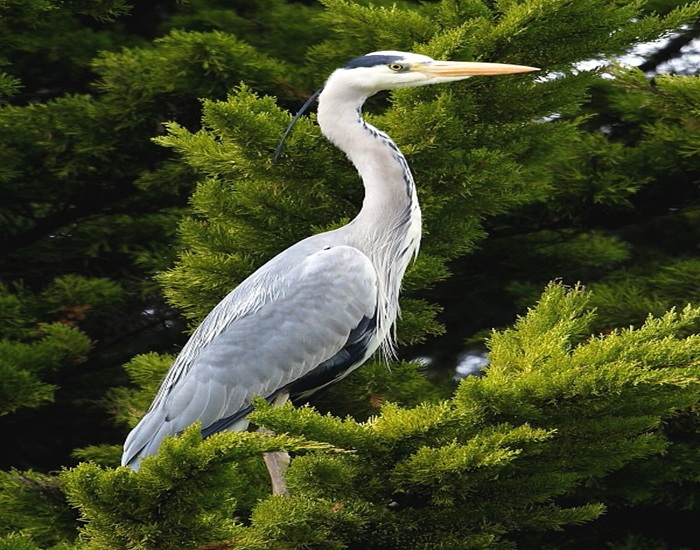
There’s something almost prehistoric about a grey heron’s profile. I’ve guided beginner birdwatchers who’ve mistaken them for statues until they moved. What makes them so distinctive isn’t just their height (they can reach over a metre tall) but their proportions: those impossibly long legs, the S-curved neck, and that dagger-sharp beak. In low light, they look like sentinels guarding the water’s edge.

According to the Natural History Museum, the grey heron’s plumage serves as perfect camouflage in the reed beds and grey skies of Britain. I’ve watched them disappear against willow trunks and grey stones. The National Audubon Society notes similar adaptations in their American cousins, proving this design works across continents.

What many people miss is the subtle beauty in their plumage up close. The grey isn’t flat; it has blue and lavender tones in certain lights. I once photographed one in early morning light, and the feathers showed hints of colour I’d never noticed before. For another bird with understated elegance, consider the turtle dove, whose soft beauty reveals itself on closer inspection.

With a wingspan that can stretch nearly two metres, they’re impossible to overlook once they take flight.

2. Impressive Wingspan: How the Grey Heron Bird Glides with Grace

I’ll never forget the first time I saw a heron take off right in front of me. It didn’t flap frantically like smaller birds; it unfolded those enormous wings and seemed to simply step into the air. The sound is distinctive too: a slow, powerful whoosh whoosh that carries across water. They don’t fly so much as command the airspace above them.

What makes their flight so efficient is that massive wingspan. The Royal Society for the Protection of Birds (RSPB) confirms they can reach nearly 2 metres across. I’ve measured wingspans during banding work, and holding those wings is humbling. They’re both strong and delicate. The characteristic neck retraction into an “S” shape isn’t just for aerodynamics; it protects that long, vulnerable neck during flight.

The National Wildlife Federation explains that this gliding ability lets them cover long distances with minimal energy. I’ve tracked them flying between feeding grounds, and they’ll often catch thermals to gain height before gliding down to the next spot. It’s energy-efficient hunting on a grand scale.

Unlike many birds that scatter at the first sign of danger, herons often assess before flying. I’ve approached them slowly (for photography, always keeping distance), and they’ll watch you, calculate the threat, then lift off with deliberate wingbeats. It’s the difference between panic and strategy.

For another master of aerial hunting, our guide on the osprey’s hunting behavior shows similar evolutionary brilliance in flight.

3. Adaptive Feeding: The Grey Heron’s Smart Hunting Techniques

Heron watching taught me patience. I’ve sat in hides for hours, watching the same bird stand motionless in shallow water. Then, in a blink, it strikes. The speed is astonishing. What looks like idleness is intense concentration. They’re reading the water, calculating angles, waiting for the perfect moment. This isn’t random hunting; it’s tactical predation.

According to the Scottish Wildlife Trust, their diet is incredibly varied. I’ve seen them take fish, obviously, but also frogs, voles, and once, a small water bird. The key is adaptability. In winter, when ponds freeze, they’ll hunt in different locations or switch prey. During banding work, I’ve examined stomach contents (from deceased birds found naturally) and found everything from sticklebacks to beetles.

Their urban adaptation fascinates me most. I’ve watched herons in city parks learn that certain benches mean people with bread (which they’ll take, though it’s not ideal for them). Some even recognize individual park keepers who feed fish. The Wildlife Trusts note that this behavioral flexibility is key to their success. They’re problem solvers.

This intelligence isn’t unique to herons. For another example of avian problem-solving, the ground-dwelling parrots of New Zealand show similar environmental adaptation.

4. Global Reach: Where the Grey Heron Bird Can Be Found Today

One of my favourite aspects of studying herons has been connecting with observers worldwide. Through birding networks, I’ve compared notes with watchers in Japan, South Africa, and Norway. The grey heron’s range is genuinely impressive. From Scottish lochs to Japanese rice paddies, they’ve found similar ecological niches. Their presence often indicates healthy wetlands, regardless of continent.

According to BirdGuides, they occupy diverse habitats from sea level to mountain lakes. I’ve seen them in the Lake District at altitude and along the Thames estuary mudflats. This flexibility explains their success. They don’t need pristine wilderness; they need water with food.

Migration patterns vary. In the UK, many are residents, but northern European populations move south. The Bird Ecology Study Group tracks these movements. I’ve participated in ringing programs where birds banded in the Netherlands were recovered in Spain. Their journeys can be substantial.

While not in the Americas (that’s the great blue heron’s territory), the eBird platform by the Cornell Lab of Ornithology documents rare vagrants appearing in unexpected places. Bird distribution constantly surprises us.

For another globally successful bird, our post on budgerigar birds explores adaptation in very different environments.

5. Quiet Hunters: Why Grey Herons Are Nature’s Silent Predators

Silence is their weapon. I’ve sat close enough to hear the slight crunch when they adjust their footing on gravel, but that’s often the only sound. They don’t vocalize while hunting. This quiet intensity makes them incredibly effective. Fish don’t hear them coming. Even their strike is mostly silent, just a quick splash, and it’s over.

As described by Wikipedia.org, their hunting strategy combines patience with explosive speed. I’ve timed them standing motionless for over thirty minutes before striking. This isn’t passive waiting; it’s active surveillance. Their eyes are constantly scanning, heads making micro adjustments to follow movement below the surface.

The Wildfowl & Wetlands Trust (WWT) explains this energy conservation strategy. Why waste energy chasing when you can let prey come to you? It’s the same principle big cats use. Maximum reward for minimum effort.

Their camouflage completes the package. I’ve had people walk right past herons without noticing them. They become part of the landscape, grey on grey, still among moving reeds.

For more on avian intelligence and strategy, our guide to fun facts about parrots explores different cognitive adaptations.

6. Wetland Warriors: The Role of Grey Herons in Ecosystem Health

Early in my conservation work, I learned that herons are indicator species. A healthy heron population usually means a healthy wetland. They’re not just residents; they’re regulators. By preying on fish, they prevent any one species from dominating. This creates space for biodiversity. I’ve seen ponds without predator balance become choked with certain fish species; herons help maintain equilibrium.

According to en.Wikipedia.org, their role extends beyond population control. Their nesting colonies, called heronries, become nutrient hotspots. Droppings fertilize the soil below, promoting plant growth. It’s a natural cycle of nutrient movement from water to land.

The Royal Society for the Protection of Birds (RSPB) monitors heronries as environmental barometers. I’ve assisted with surveys where declining numbers alerted us to water quality issues before other signs appeared. They’re our early warning system.

Their contribution to nutrient recycling is often overlooked. In large heronries, the ground becomes enriched naturally. This benefits the surrounding vegetation without artificial fertilizers. It’s a perfect example of ecosystem services.

For another bird with important environmental roles, our article on cockatoo care and behavior explains how parrots support forest health.

7. Family Life: What You Didn’t Know About Grey Heron Nests

Most people see herons as solitary, but breeding season reveals their social side. I’ll never forget my first visit to a large heronry. The noise, the activity, the sheer scale of it. Dozens of massive stick nests high in trees, adults coming and going, chicks squawking. It’s one of Britain’s great wildlife spectacles, yet many don’t know it exists.

These communal sites, called heronries, can be decades old. I’ve monitored one that’s been active for over forty years. The British Trust for Ornithology (BTO) explains that they often return to the same trees, adding to nests each year. Some become so large that they threaten the supporting branches.

A Delicate Yet Strategic Parenting Process

Parenting is intensive. Both adults share duties: incubating eggs, guarding the nest, and feeding chicks. I’ve watched adults make countless fishing trips to satisfy growing chicks. The coordination is impressive; they take turns so one is always on guard against predators like crows or gulls.

The RSPB recommends keeping a distance during the breeding season. Disturbance can cause nest failure. Many reserves have viewing hides where you can watch without intrusion. I always advise using them; they protect the birds while allowing observation.

For more on avian family dynamics, our fun facts about parrots cover similar parenting strategies in different species.

8. Migratory Marvels: Tracking the Seasonal Journey of the Grey Heron Bird

Migration patterns reveal much about a species. UK herons are mostly resident, but ring recovery data show interesting movements. I’ve handled birds ringed as chicks here that were recovered in France months later. Younger birds especially disperse widely, exploring new territories before settling.

Migration Patterns and Distances

According to the Bird Migration Atlas, northern populations show more defined migration. Birds from Scandinavia move south to escape frozen waters. Some reach Africa. These journeys aren’t random; they follow traditional routes, often along river valleys.

Juvenile dispersal fascinates me. Young herons leave their natal areas to reduce competition. I’ve seen them turn up in unusual places: small urban ponds, reservoirs, even flooded fields miles from typical habitat. This exploratory phase helps them find new territories.

For insights into supporting birds through seasonal changes, our article on winter care tips offers practical advice for helping all wildlife.

9. Fascinating Behaviors: Unique Habits That Make the Grey Heron Special

Beyond hunting, herons display behaviors that reveal their intelligence. I’ve observed what I can only describe as play in young herons: picking up sticks, dropping them, chasing leaves. This isn’t just a random activity; it’s skill development. They’re practicing coordination, learning object manipulation.

Tool Use and Territory Tactics

The bait fishing reports fascinate me. While I haven’t witnessed it personally, credible observers document herons using feathers or insects as lures. As reported by the Heron Wikipedia, this shows problem-solving ability. It suggests they understand cause and effect: drop object, fish investigates, catch fish.

Territorial displays are dramatic. During breeding season, males perform stretching displays, pointing their bills skyward, and calling loudly. It’s both a warning and an advertisement. Outside breeding, they become secretive, avoiding conflict unless necessary. This seasonal shift in behavior shows social flexibility.

These behaviors illustrate why herons succeed. They’re not just instinct-driven; they’re adaptable, observant, and capable of learning.

For more unique avian traits, our guide on ground-dwelling parrots explores different evolutionary adaptations.

12 Amazing Facts About the Graceful Grey Heron Bird You'll Love
12 Amazing Facts About the Graceful Grey Heron Bird You’ll Love

10. Cultural Symbolism: The Grey Heron’s Place in History and Art

The grey heron has inspired artists and storytellers for millennia. What strikes me is how similar themes emerge across cultures: patience, wisdom, transition. In my travels, I’ve seen heron motifs in Japanese art, Egyptian hieroglyphs, and Celtic designs. The consistency suggests something universal in how humans perceive this bird.

The Heron in Art and Literature

In Japanese folklore, herons symbolize purity and are considered messengers. Traditional dances mimic their movements. This cultural integration shows deep observation and respect.

European traditions often portray herons as solitary, contemplative figures. Medieval bestiaries describe them standing on one leg in meditation. This connection between physical stillness and mental focus resonates across time.

For more on avian symbolism, our article on fun facts about parrots explores cultural connections with these intelligent birds.

11. Conservation Efforts: Protecting the Grey Heron’s Habitat

While grey herons aren’t currently threatened, their conservation tells a positive story. Legal protection works. The Wildlife and Countryside Act 1981 makes harming herons or their nests illegal. This simple legislation has been remarkably effective. I’ve seen nests in surprising places that survive because people know not to disturb them.

Habitat Preservation and Legal Protections

The British Trust for Ornithology (BTO) monitoring shows population stability. Water quality improvements since the 1970s have helped. Cleaner rivers mean more fish, which means healthier herons. It’s a simple equation with profound results.

International efforts matter too. Organizations like the North Carolina Wildlife Federation show how habitat creation supports heron relatives. Their success with nesting platforms proves simple interventions can make big differences.

For those interested in practical conservation, our article on winter care tips offers ways to support all birds through challenging seasons.

12. Urban Adaptation: The Grey Heron Thriving in Cityscapes

Urban herons fascinate me. I’ve studied them in London parks, watching them navigate human activity. They’ve learned traffic patterns, recognize regular visitors, and exploit new food sources. One heron in a park I monitor has learned that the ice cream van means dropped food. It waits nearby when the van arrives.

From Wetlands to City Streets

In Amsterdam, herons are part of city life. Locals know them, sometimes name them. They perch on bridges, hunt in canals, and ignore bicycles and boats. This adaptation isn’t accidental; it’s behavioral evolution in real time. (Wikipedia). Similarly, UK urban herons use parks with ponds, showing flexibility (RSPB).

Their success in cities shows how wildlife can coexist with humans when we provide space. For ideas on creating wildlife-friendly spaces, our article on creating the perfect cat-friendly home includes tips that benefit all creatures.

Spiritual Meaning: What the Grey Heron Bird Represents in Symbolism

Beyond biology, herons speak to something deeper in human experience. Their stillness reminds us to pause. Their patience teaches timing. Their solitary nature suggests comfort in one’s own company. I’ve spoken with people who find herons during difficult times, and they often describe it as meaningful.

Across traditions, common themes emerge. Native American views emphasize self-reliance. Chinese symbolism connects them with longevity. Celtic traditions see them as messengers between worlds. These interpretations, while culturally specific, share recognition of the heron’s distinctive qualities.

Whether you take spiritual meaning literally or metaphorically, herons remind us of values worth cultivating: observation before action, calm in chaos, strength in stillness. In our rushed world, perhaps we need heron wisdom more than ever.

Takeaway

The grey heron bird embodies what I love about wildlife watching: there’s always more to discover. What looks like a simple grey bird standing in water reveals layers of complexity, intelligence, adaptation, social structure, and cultural significance. They’ve survived alongside humans for centuries, adapting to our changing world while maintaining their essential nature.

Next time you see one, take a moment. Watch how it moves, how it waits, how it exists in its environment. There’s wisdom in that observation. Protecting wetlands, supporting conservation, and simply appreciating their presence enriches our world. Herons remind us that wildness persists, often closer than we think.

For more bird exploration, our posts on the ruddock bird or first-time bird care offer different perspectives on avian life.

FAQ

What does a grey heron bird look like?

Tall and slender with ash grey plumage, white neck with black streaks, and a yellow dagger-like bill. Stands about 100 cm tall. In flight, the neck retracts into a distinctive S shape.

What kind of body style does a grey heron have?

Streamlined for stealth hunting. Long legs for wading, broad wings for gliding flight, sharp beak for spearing prey. Built for stillness followed by explosive movement.

Are grey herons solitary or social birds?

Both. Solitary hunters but social breeders. Nest in colonies called heronries during the breeding season, then return to solitary hunting territories.

Can grey herons live in cities?

Yes, remarkably well. Common in urban parks, canals, and gardens with ponds. They adapt to human presence and learn to exploit urban food sources.

Are grey herons protected in the UK?

Yes, under the Wildlife and Countryside Act 1981. It’s illegal to harm them or disturb active nests. Many reserves protect breeding colonies.

About Author

Smith Sam brings research expertise to the PetsFilled team, specializing in pet behavior and naming trends. With a background in scientific communication, Smith translates animal behavior research into practical guidance for pet owners.

At PetsFilled, Smith leads naming trend analysis and contributes to comprehensive pet care guides. Their work involves analyzing naming data from shelters nationwide, researching name choices' impact on training, and interviewing veterinary behaviorists.

All articles undergo PetsFilled's editorial review and are vetted by our veterinary advisory board.