
Budgie Care Guide: Cage, Diet, Social Needs and Health

Budgies are small parrots, but their care is not small. They need enough room to move, a balanced diet, social contact, safe flight, predictable sleep, varied perches, things to chew and forage, and owners who notice subtle health changes early.
The easiest way to think about budgie care is to build the day around five needs: safe housing, appropriate food, movement, social/mental activity and health monitoring. When one of those is missing, problems often appear somewhere else.
Start with a cage that supports movement
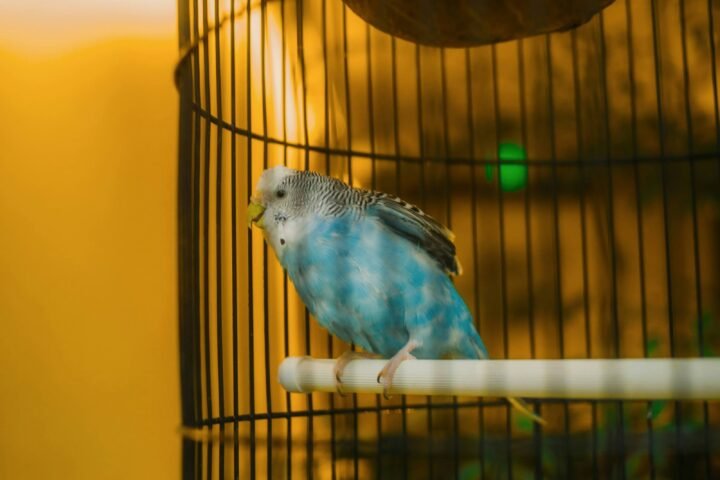
A budgie cage should be wide enough for meaningful movement between perches. Horizontal space is more useful than a very tall narrow cage because budgies fly across rather than only climbing upward.
The bird should be able to spread both wings fully without striking bars, dishes or toys.
Cage bar spacing matters
Bars must be close enough that the budgie cannot push the head through and become trapped. Check the manufacturer’s actual spacing rather than relying on a generic “small bird” label.
Where the cage sits changes daily welfare
Place the cage where the bird can be part of normal household life without sitting in a constant traffic lane. Avoid kitchens, strong drafts, direct midday sun, smoke, aerosols and heavily scented areas.
Our bird cage placement and sleep guide covers room choice, sleep routine and common placement mistakes.
The kitchen is not a safe default
Cooking introduces heat, steam, smoke, open flames and possible non-stick fumes. Birds are especially sensitive to airborne toxins.
Use our bird-safe home guide for a broader household hazard checklist, and PTFE toxicity in pet birds for the emergency risk from overheated non-stick coatings.
Use varied perches
Offer several safe perch diameters and textures rather than identical smooth dowels. Natural wood perches can encourage varied foot position and normal movement when they are clean, stable and made from bird-safe materials.
Our bird perch guide explains materials, sizing and placement in more detail.
Perch placement matters as much as perch type
Do not place the highest preferred perch directly over food or water dishes. Avoid creating a route where droppings constantly contaminate lower perches or bowls.
Leave enough clear space for the bird to move between perches without brushing the wings against cage bars or toys.
Do not rely on seed alone
Seed-heavy diets are nutritionally incomplete for many companion birds. A species-appropriate diet commonly includes a formulated component plus suitable vegetables and other fresh foods.
Diet conversion should be gradual. A budgie can starve while appearing to have food available if the bird does not recognise the new diet as edible.
Watch what the bird actually eats
Seed husks can make a bowl look full. Pellets may be crushed and dropped. Observe intake, droppings and body weight rather than assuming the food level proves enough was consumed.
Fresh water should be easy to inspect
Change water regularly and clean dishes thoroughly. Position them where droppings are less likely to fall directly inside.
Fresh foods should be introduced gradually
Offer small amounts and remove spoiled produce before it sits too long. Avoid sudden major diet changes in a bird that is already underweight or unwell.
Budgies need social contact
Budgies are social birds. A single budgie needs meaningful daily interaction with people, while multiple birds still need enough space and resources to avoid competition.
Social contact does not mean constant handling. Talking, training, shared room time and choice-based interaction can all contribute.
A pair of budgies still needs enrichment
Two birds may interact with each other, but that does not remove the need for movement, foraging, safe toys and health monitoring.
Watch for bullying in multi-bird homes
One bird may control food, favourite perches or access to another bird. Provide multiple feeding points and enough perch options so one individual cannot monopolise every valuable resource.
Budgies need safe out-of-cage movement
Supervised flight supports exercise and normal behaviour. Use a closed room with doors and windows secured, ceiling fans off, mirrors and large glass surfaces made obvious, and other pets excluded.
Flight should not be reserved only for birds with perfect recall. The environment should be made safe enough that normal movement is possible.
Recall training is still useful
Simple step-up and recall training can make daily care and emergencies easier. Use small rewards and short sessions rather than chasing the bird around the room.
Foraging adds mental work to feeding
Hide small portions of the normal ration in paper cups, simple puzzle feeders or safe cardboard structures. Start easy so the budgie succeeds.
Foraging should add behaviour, not reduce food intake in a bird that is already thin or reluctant to eat.
Safe chewing matters
Budgies use the beak constantly. Provide bird-safe chew materials and toys that can be shredded without exposing sharp wire, loose thread or small swallowable parts.
Rotate toys without changing everything at once
Novelty can be useful, but some birds are cautious about new objects. Introduce one item at a time and leave familiar perches and core resources in place.
Sleep needs consistency
Budgies benefit from a predictable dark, quiet period each night. Household noise, televisions and late-night lighting can interrupt rest.
Our cage placement and sleep guide explains how to balance household inclusion during the day with quiet overnight conditions.
Do not cover the cage as a substitute for a good room
A cover can reduce light, but it does not remove smoke, fumes, noise or poor ventilation. The sleeping environment still needs to be safe.
Bathing can be offered, not forced
Some budgies enjoy shallow bathing dishes or a gentle mist. Others prefer neither. Use clean water and let the bird choose.
Keep the cage clean without stripping it every day
Replace cage paper, remove obvious waste and clean food/water dishes regularly. Perches and toys should be cleaned as needed.
Avoid strong scented cleaners and rinse thoroughly before the bird returns.
Watch the droppings every day
Droppings provide useful information about intake and health. Persistent changes in colour, amount or consistency can matter, especially when paired with appetite or behaviour change.
Our bird droppings guide explains what to monitor.
Weighing is one of the most useful home health checks
Feathers can hide weight loss. Use a gram scale and record the trend under similar conditions.
Our bird weighing guide explains how to measure without stressful restraint, while bird losing weight covers what a downward trend can mean.
Learn subtle illness signs
A budgie that stays fluffed for long periods, sleeps much more, sits low, eats less, changes droppings, loses weight or breathes differently may be sick.
Our budgie signs of illness guide focuses on these early changes.
Breathing trouble is urgent
Open-mouth breathing, pronounced tail bobbing, wheezing, clicking or visible effort at rest deserves prompt veterinary attention.
Use our bird breathing problems guide for this symptom cluster.
Vomiting is not always normal regurgitation
Budgies may regurgitate during courtship or social behaviour, but true vomiting can be messy and may accompany weakness or illness.
When you are unsure and the bird looks unwell, contact an avian veterinarian.
Know the emergency signs
Breathing difficulty, collapse, seizures, inability to perch, active bleeding, repeated vomiting, major trauma and rapid deterioration are reasons for urgent avian veterinary care.
Our bird emergency warning-signs guide gives a full triage framework.
Have an avian veterinarian before you need one
Not every veterinary clinic treats birds. Save the details of an avian or exotics service in advance.
The Association of Avian Veterinarians provides companion-bird care resources and is a useful starting point for evidence-based avian information.
Use a travel carrier that is ready to go
Keep a small secure carrier available for emergencies. A weak bird may need a low perch or padded floor rather than the normal travel setup.
Do not medicate from the human medicine cabinet
Birds are small and physiologically different from people. Human painkillers, antibiotics and respiratory remedies can be dangerous or inappropriate.
Do not wait for a budgie to look dramatically sick
Birds often hide illness. A meaningful change from normal—less eating, less vocalising, sitting low, new breathing effort or a falling weight trend—is enough reason to call an avian clinic.
A realistic daily routine
- Check food and water in the morning.
- Remove obviously soiled cage paper and dishes.
- Offer suitable fresh food.
- Provide interaction, foraging and movement.
- Observe droppings and activity.
- Notice whether the bird is behaving like itself.
- Provide a predictable dark, quiet sleep period.
A weekly care review
- Record body weight.
- Inspect perches and toys for wear.
- Clean the cage more thoroughly as needed.
- Review nail and beak condition visually.
- Check for changes in feet, feathers and droppings.
- Rotate enrichment gradually.
What good budgie care looks like
A well-cared-for budgie has room to move, food that supports long-term health, predictable rest, safe social contact, opportunities to forage and chew, and an owner who notices subtle change early.
Small body size should never be mistaken for simple care. Budgies thrive when their environment is designed around normal parrot behaviour rather than around keeping the smallest possible cage tidy.
Read body language during handling
A budgie that leans away, pants, bites repeatedly or frantically escapes is not ready for more handling. Training should preserve choice. Step-up practice works best when the bird can leave rather than being chased around the cage.
Hands should predict safety
Move slowly, avoid grabbing from above and reward voluntary approach. Some budgies become comfortable with hands quickly; others need weeks. The pace should be set by the bird’s confidence rather than the owner’s schedule.
Mirrors are not a substitute for companionship
Some budgies become intensely focused on mirrors and may regurgitate to or defend the reflection. Occasional mirror exposure is not automatically harmful, but constant fixation can interfere with normal social and foraging behaviour.
Hormonal behaviour needs environmental management
Dark nest-like spaces, huts and prolonged daylight can encourage reproductive behaviour in some birds. Avoid providing enclosed nesting sites unless breeding is intentional and professionally managed.
Do not pet the body like a dog or cat
Many parrots interpret stroking over the back, wings or lower body as sexual behaviour. Head and neck interaction is generally less likely to encourage reproductive responses.
Foot health deserves routine attention
Watch for redness, swelling, pressure sores, overgrown nails or reluctance to grip. Identical smooth dowels can concentrate pressure on the same part of the foot, which is why varied perch diameter matters.
Beak growth should be observed, not filed casually
A normal budgie beak is continuously growing and wearing. Sudden overgrowth, flaking, deformity or difficulty eating can point to medical problems. Do not file or clip the beak at home without avian veterinary guidance.
Nail length is about function
Nails should allow secure grip without curling excessively or snagging constantly. Abrasive perch covers are not a safe substitute for appropriate trimming because they can damage footpads.
Fresh-air exposure needs bird-safe planning
Open windows, ceiling fans, cooking fumes and outdoor escape risk make casual “airing out” unsafe. If a bird is taken outdoors, use a secure travel cage or properly fitted avian harness with training rather than relying on clipped wings.
Wing clipping does not make an open room safe
Clipped birds can still glide, catch wind or escape outdoors. Clipping also does not remove the need for exercise. Discuss flight management with an avian veterinarian or experienced behavior professional rather than using clipping as the only safety strategy.
Household plants and metals can be hazards
Budgies explore with the beak. Check plants, curtain weights, jewelry, hardware and painted surfaces before allowing free flight. Heavy-metal exposure can occur when birds chew unsafe metal objects.
Kitchen and cleaning routines affect the bird
Move the bird away from aerosol sprays, strong cleaners, smoke and heated non-stick products. Good ventilation helps household air quality but is not a substitute for removing the source of a toxin.
Use training as enrichment
Short sessions teaching step-up, target touching or recall can provide mental work and improve practical handling. Keep sessions brief and reward-based.
Do not train through hunger
Food rewards can be useful, but the bird should not be deprived of normal nutrition to make training work. Use tiny rewards within the daily diet.
Watch for subtle social withdrawal
A normally interactive budgie that stops calling, avoids a companion or no longer joins routine activity may be ill even if there is no dramatic physical sign.
Use weight and droppings together
A falling weight trend plus smaller or fewer droppings can suggest reduced intake. That combination deserves faster attention than either observation alone.
Changes in sleep can matter
A bird sleeping much more during the day, especially while fluffed and less responsive, should be monitored closely. Daytime sleep is not automatically abnormal, but a sustained change from the bird’s usual pattern is meaningful.
Plan for emergencies before they happen
Keep the carrier, clinic number and basic medical history easy to find. In an emergency, knowing where to go matters more than searching for the perfect home remedy.
The best care routine is consistent, not complicated
Budgies do not need constant novelty or handling. They need a stable safe cage, balanced diet, opportunities for flight and foraging, predictable social interaction and owners who notice change early.
0 comments