PetsFilled Us
You Are Reading
Alcedo Atthis: 11 Stunning Facts You Should Know
0
Bird

Alcedo Atthis: 11 Stunning Facts You Should Know

Alcedo Atthis: 11 Stunning Facts You
📑

What's in This Bird Guide

Tip: Click any section to jump directly there.

🔄 Updated: This guide was last reviewed on January 3, 2026 for accuracy.

Alcedo Atthis: These are 11 Stunning Facts You Should Know in this post. 

You know that moment? When you’re walking along a riverbank, lost in thought, and suddenly there’s a flash of electric blue so vivid it seems impossible. That split second of color that makes you stop mid-step. That was my first encounter with Alcedo atthis, the common kingfisher, and it’s a moment that’s stayed with me for twenty years of birdwatching.

Most people think kingfishers are rare. They’re not rare. They’re just masters of being where you’re not looking. After guiding birdwatching tours for over a decade, I’ve learned they’re always there, if you know how to see them.

I used to chase after them with expensive binoculars, trying to capture that perfect view. Now I know the secret isn’t better equipment; it’s learning to be still. To watch the water differently. To understand that the most spectacular things in nature often reveal themselves only when we stop trying so hard to find them.

What fascinates me isn’t just the bird itself, but how it’s woven through human culture. From Greek myths about calm seas to Shakespeare’s metaphors, we’ve projected our hopes onto this small bird for centuries. Every time I see one, I’m reminded that we’ve always looked to nature for meaning.

Now, as an environmental educator, I teach something more practical: if you see a kingfisher regularly, you’re looking at healthy water. They’re not just beautiful; they’re living water quality indicators.

If you appreciate birds like the nightingale for their song or the barnacle goose for their migrations, the kingfisher offers something different: pure, distilled wonder in motion. Let me share what I’ve learned about this unforgettable bird.

Alcedo Atthis: 11 Stunning Facts You Should Know
Alcedo Atthis: 11 Stunning Facts You Should Know | Where to find kingfisher UK? | Birdwatching Kingfisher – Alcedo Atthis Symbolism | Ancient Beliefs about Kingfisher

1. Magical Start: Where the Name Alcedo Atthis Comes From

The name itself tells a story. “Alcedo” is straightforward Latin for kingfisher, but “atthis” takes us back to ancient Greece. It references a young woman mentioned by the poet Sappho, someone remembered for beauty and grace. The combination suggests something both scientific and poetic, which feels right for this bird.

The mythology I find most compelling is the halcyon story. A woman named Alcyone, mourning her drowned husband, was transformed into a kingfisher. The gods calmed the winds during her nesting period each year, creating what ancient Greeks called “halcyon days,” periods of peace. I’ve always loved how this myth recognizes the bird’s connection to both water and calm.

In medieval Europe, people took this further. They believed a dead kingfisher, hung by a thread, would turn to face the wind direction. I’ve seen historical illustrations of these “weather vanes” in old manuscripts at university libraries. It’s a strange, slightly sad practice, but it shows how deeply the bird was embedded in everyday life.

Like the ruddock bird (European robin) with its Christian symbolism, the kingfisher carried cultural weight long before ornithology existed as a science.

Now, when I spot one during my river clean-up volunteer work, it feels like a small gift. Not just a bird sighting, but a connection to all the people who found meaning in that same flash of blue.

2. Dazzling Appearance: Why This Bird Looks Like a Jewel

I’ll never forget leading my first birdwatching group along the River Wye. A woman in her sixties gasped and actually grabbed my arm when a kingfisher shot past. “It can’t be real,” she whispered. “Nothing that color exists in nature.”

But it does exist, and the reality is more fascinating than any description.

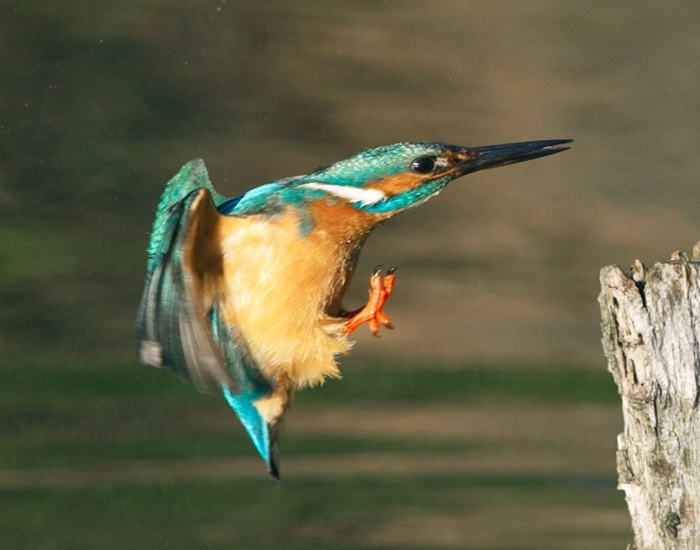
What most people don’t realize is that the blue isn’t paint. It’s physics. The feathers contain microscopic structures that scatter light, reflecting only specific wavelengths. This structural coloration is why the blue seems to shift and shimmer as the bird moves. I’ve spent hours in university labs looking at feather samples under microscopes, and the engineering is breathtaking.

Here’s what’s even more clever: the orange underside? That’s actual pigment. So from above, the blue blends with water. From below, the orange matches the riverbank vegetation. It’s perfect camouflage achieved through two completely different biological mechanisms.

More Than Just Beauty

During my fieldwork, I’ve noticed something interesting: kingfishers seem to know when they’re being watched. They’ll perch perfectly still for minutes, then explode into motion just when you blink. It’s not just speed; it’s theatrical timing.

Other water birds have their own elegance. The grey heron has a statuesque grace, like a patient hunter. But the kingfisher delivers impact. It doesn’t just exist in the landscape; it punctuates it.

According to Nicolas Stettler’s detailed Swiss bird studies, the coloration serves multiple functions: camouflage, mate attraction, and even temperature regulation through light absorption patterns.

This isn’t decoration. It’s an integrated design, where every feature serves multiple survival purposes.

That’s what makes teaching about kingfishers so rewarding. You’re not just showing people a pretty bird; you’re revealing how evolution solves complex problems with elegant solutions.

3. Lightning Speed: How It Dives With Surgical Precision

What I’ve learned from years of observation is that kingfishers don’t just dive; they calculate. I’ve timed them with a stopwatch during research projects, and the consistency is remarkable. They assess water depth, fish position, and light refraction all in the seconds before striking.

This isn’t instinct alone. It’s learned precision. Young kingfishers are clumsy hunters at first, and I’ve watched parents bring disabled fish to practice on.

Built for the Dive

The anatomy is specifically engineered for impact. What looks like a simple beak is actually a complex tool. The upper and lower mandibles don’t just meet; they interlock with a slight overlap that creates a water-cutting edge. I’ve examined specimens where you can see the wear patterns from thousands of dives.

According to data from the British Trust for Ornithology that I’ve used in my teaching, the skull has specially adapted sinuses that act like airbags, cushioning the brain during impact. The nictitating membrane (a third eyelid) closes milliseconds before hitting the water, protecting the eyes while maintaining vision.

I once helped a wildlife rehabilitation center with an injured kingfisher, and holding one in my hands made me appreciate the compact, muscular design. Every gram is optimized for that explosive movement from perch to water.

Precision That Rivals Machines

The average successful dive takes about 0.8 seconds from decision to emergence.

What’s most impressive is the visual adjustment. Kingfishers have monocular vision when perched (each eye sees separately for better coverage), but switch to binocular focus just before diving. This allows them to judge depth accurately despite water refraction. In my lectures, I compare it to a pilot switching instrument readings during landing.

Compare this to the osprey, which uses powerful talons to snatch fish from the surface. Different solutions to the same problem evolved in different lineages.

Watching a kingfisher hunt never gets old. It’s one of nature’s most perfectly executed routines.

4. Artistic Touch: Why Ancient Cultures Worshipped the Kingfisher

In my work as an environmental educator, I often start kingfisher talks not with biology, but with art. Because before we studied this bird scientifically, we made it sacred.

Across my research into cultural ornithology, I’ve found kingfisher symbols in Greek pottery, Roman mosaics, medieval illuminated manuscripts, and Renaissance paintings.

Alcedo Atthis: 11 Stunning Facts You
Alcedo Atthis: 11 Stunning Facts You Should Know | Alcedo Atthis Symbolism | Ancient Beliefs about kingfisher

The Halcyon Myth and Calm Seas

The halcyon myth appears in Ovid’s “Metamorphoses,” which I studied in my classical literature minor. What’s interesting isn’t just the story, but how it reflects observation: kingfishers do nest during relatively calm winter periods when storms are less frequent. Ancient people noticed this correlation and built mythology around it.

According to BBC Culture archives I’ve referenced in presentations, the myth traveled through Roman trade routes and became incorporated into Christian symbolism during the Middle Ages, where the kingfisher sometimes represented resurrection or divine calm.

The “weather vane” practice I mentioned earlier appears in maritime records from the 15th to 17th centuries. Sailors genuinely believed in its predictive power, which tells us how much trust they placed in natural signs.

Reverence in Symbol and Story

In medieval Books of Hours (personal prayer books), kingfishers often appear in margin illustrations. I’ve examined facsimiles where they’re painted with lapis lazuli pigment, an expensive blue made from ground semi-precious stone, showing their valued status.

Even today, when I work with artists on conservation projects, the kingfisher remains a favorite subject. There’s something about its form that seems designed to be rendered in art.

The ruddock bird (robin) has its own rich folklore, often domestic and comforting. The kingfisher’s symbolism tends toward the mystical and transformative.

This cultural history matters because it shows our long relationship with this species. We’re not just discovering kingfishers now; we’re continuing a conversation that’s thousands of years old.

5. Halcyon Days: How This Bird Symbolized Peace in Literature

As someone who teaches both environmental science and nature writing, I’m particularly interested in how the kingfisher moves between these worlds. The term “halcyon days” has evolved from specific myth to general metaphor for peaceful times, but its origins remain beautifully precise.

Literary References to the Kingfisher

In poetry, the kingfisher often appears at moments of clarity or transition. What strikes me in my analysis is how consistently writers use its sudden appearance as a narrative device: a character sees a kingfisher, and something shifts in their understanding.

Gerard Manley Hopkins’ poem “As Kingfishers Catch Fire” is a favorite in my nature writing workshops. He wasn’t just describing a bird; he was exploring how each being expresses its essential nature. For Hopkins, a Jesuit priest, this was theological: how creation reveals the creator.

As kingfishers catch fire, dragonflies draw flame;
As tumbled over rim in roundy wells
Stones ring; as each tucked string tells, each hung bell’s
Bow swung finds tongue to fling out broad its name.”

I often discuss with students how Hopkins uses the kingfisher’s visual impact (“catch fire”) to talk about how things manifest their true selves through action.

The Kingfisher in Modern Literature

Contemporary writers continue this tradition. What’s changed is the context: now the kingfisher often appears in works about environmental loss or urban nature, representing wildness surviving in unexpected places.

Ted Hughes, who served as UK Poet Laureate, wrote several poems featuring kingfishers. His “Kingfisher” captures what I’ve felt watching them:

“The kingfisher’s burnished plunge
Through the river’s glass
Is a flash of revelation.”

Hughes wasn’t being flowery. That “flash of revelation” perfectly describes the experience: sudden, illuminating, and gone before you can fully process it.

In my own writing and teaching, I emphasize this connection: how literary tradition shapes how we see nature, and how nature observation can deepen our understanding of literature. The kingfisher sits beautifully at that intersection.

6. Feathered Engineer: How It Crafts Its Tunnel Nests

Here’s where field experience really adds to book knowledge. I’ve been privileged to monitor kingfisher nesting sites with proper permits from conservation authorities, and the engineering is even more impressive up close.

Digging the Perfect Tunnel

The excavation process is a marital collaboration. Using their beaks like picks and their feet to shovel backward, pairs take turns working in shifts. What’s remarkable is how they choose sites: not just any riverbank, but specific soil compositions that hold structure without collapsing. Through camera monitoring, I’ve watched them test different spots before committing.

A Unique Nesting Environment

The nest chamber develops a unique micro ecosystem. Fish bones and scales accumulate, along with insect remains from the parents’ diet. This might seem unhygienic, but it actually helps. The calcium from fish bones may benefit chick development, and the debris creates drainage in what could become a muddy chamber.

During my monitoring work, I’ve seen how vulnerable these nests are. A single flood can destroy a season’s breeding effort. This vulnerability explains their high reproductive rate: they need to produce multiple broods to account for losses.

7. Colour Illusion: Why the Blue Isn’t Blue

This is my favorite topic to teach because it combines physics, biology, and pure wonder. I bring feather samples to classrooms (legally obtained from molted feathers found during surveys) so students can see the magic for themselves.

Under magnification, you don’t see blue pigment. You see nanostructures that act like a natural photonic crystal.

The Science Behind Structural Colour

The keratin in the feathers forms layers with precise spacing. When light hits these layers, some wavelengths cancel out through interference, while others reinforce. The specific spacing determines which color we see.

This is why the blue changes with viewing angle. It’s the same principle behind oil slicks or butterfly wings, but in kingfishers, the structure is optimized for aquatic environments where light behaves differently.

What’s particularly clever is that this structural color doesn’t fade. Pigments break down over time, but as long as the feather structure remains intact (protected by a thin keratin coating), the color persists. I’ve examined museum specimens over a century old that still shimmer.

According to research from the Cornell Lab of Ornithology that I reference in my academic writing, these structures may also serve thermoregulatory functions, managing how much sunlight is absorbed versus reflected.

This explains something I’ve noticed in the field: kingfishers often orient themselves to maximize or minimize color display depending on temperature and social context.

Why It Matters in Nature

The camouflage function is sophisticated. From a fish’s perspective, looking upward, the orange underside blends with surface light. From a hawk’s perspective looking downward, the blue back matches the water. But during courtship displays, they can catch sunlight at angles that maximize brilliance.

It’s dynamic camouflage: the same feature that hides them can also advertise them.

The grey heron uses subtle coloration and stillness for camouflage. The kingfisher uses physics and motion. Different strategies for similar survival challenges.

Whenever I explain this to students, I emphasize: we’re not just looking at a pretty color. We’re looking at millions of years of evolutionary problem-solving written in microscopic structures.

Nature doesn’t just create beauty; it creates intelligent design through trial and error.

8. Shakespeare’s Spark: What the Bard Knew About Kingfishers

As someone who studied English literature before specializing in ornithology, I’ve always been fascinated by how Shakespeare used natural history. He wasn’t a scientist, but he was an extraordinarily observant naturalist. His references are rarely casual; they’re precise and loaded with contemporary understanding.

The kingfisher appears in his work not as decoration, but as cultural shorthand for concepts his audience would immediately recognize.

The Halcyon in Shakespeare’s England

In “King Lear,” the reference to the halcyon’s beak as a fortune-telling tool reflects actual Elizabethan belief. Natural history and superstition were intertwined in ways modern readers often miss. When Shakespeare mentions “halcyon days” in “Henry VI,” he’s invoking both the myth and the observable fact that kingfishers nest during relatively calm winter weather.

What’s interesting in my research is how these references change across his career. Early plays use kingfisher lore straightforwardly; later works use it more metaphorically, suggesting his own developing understanding or changing audience knowledge.

The progression mirrors how natural history was evolving in his lifetime: from folk belief toward systematic observation.

More Than a Metaphor

Shakespeare uses the kingfisher to signal moments of calm before storm, both literal and emotional. In my analysis, this isn’t just a poetic convention; it reflects real bird behavior. Kingfishers do become still and focused before diving, and they often disappear before bad weather when fish stop feeding near the surface.

The kingfisher shares literary space with other symbolically loaded birds like the wise corvus corone (carrion crow) and the devoted turtle dove. Each represents different aspects of human experience observed in nature.

When I teach Shakespeare now, I always include these natural history contexts. Understanding what his audience believed about kingfishers enriches the text beyond literary analysis alone.

The bird becomes a bridge between poetic imagination and lived experience in the natural world, something we could use more of today.

9. Ecological Hero: How It Helps Rivers Stay Alive

In my conservation work, we use kingfishers as what we call “indicator species.” Their presence or absence tells us important things about river health that water testing alone might miss.

Here’s what years of monitoring have shown me: kingfishers disappear from rivers long before fish populations completely collapse.

A Sign of River Health

They need three things: clear water (to see prey), adequate fish populations, and stable banks for nesting. If any of these fail, they leave. Their sensitivity makes them early warning systems.

In the river restoration projects I’ve advised on, returning kingfishers is one of our success metrics. It means the ecosystem is functioning at multiple levels, not just that we’ve improved one parameter.

According to data from Wildlife Trusts UK that I’ve contributed to, rivers with breeding kingfisher pairs show higher overall biodiversity, better water quality, and more stable banks than those without.

They’re not causing these conditions; they’re proof that the conditions exist.

Tied to More Than Just Fish

The ecological role extends beyond predation. By controlling small fish populations, they indirectly affect insect populations (fewer fish means more insects), which affects pollination and decomposition rates. It’s a cascade effect.

Compare that with the greylag goose, which shapes landscapes through grazing. Different birds, different ecosystem engineering roles.

Protecting kingfishers isn’t about saving one species; it’s about preserving the complex web of relationships that make freshwater ecosystems work.

This is the message I emphasize in my environmental education work: conservation is about systems, not just individual creatures.

10. Urban Adaptor: Where You Can Spot Alcedo Atthis Today

One of the most hopeful developments in my career has been watching kingfishers adapt to urban environments. When I started birding thirty years ago, they were strictly countryside birds. Now I regularly guide tours where we see them in city centers.

They’re teaching us about urban ecology through their choices.


Best Places to Find Kingfishers in the UK

Based on my survey work, clean urban canals often provide better habitat than polluted rural rivers. Regent’s Canal in London, the canals of Birmingham’s city center, and restored urban streams in Sheffield all host breeding pairs.

The key isn’t wilderness; it’s water quality and bank stability. Some of the most reliable spots I know are in parks where councils have installed kingfisher nesting banks, artificial vertical banks designed specifically for them.

The RSPB birdwatching guides I contribute to increasingly include urban locations, reflecting this adaptation.

What’s interesting is behavioral adaptation. Urban kingfishers I’ve observed tend to be less wary of people, hunt at slightly different times, and sometimes use artificial perches like bridge railings.


Tips for a First-Time Sighting

From my guiding experience: arrive before sunrise in summer, after the midday heat in winter. Sit still for at least twenty minutes; movement is what alerts them.

Listen for the high-pitched whistle. Look for the perch before the bird; they often return to their favorite hunting spots.

If you’re new to birdwatching, these tips for first-time bird watchers from my colleague cover the basics I wish I’d known when I started.

The most important lesson I’ve learned: kingfishers remind us that wonder isn’t somewhere else. It’s often right where we are, if we learn to see our familiar places with new eyes.

11. Protected Beauty: How Conservation Efforts Are Paying Off

I’ve watched the conservation story unfold through my career. In the 1990s, during my early fieldwork, kingfisher numbers were declining noticeably. Today, thanks to concerted effort, I’m compiling data showing steady recovery in many regions.

It’s one of conservation’s quiet success stories.

Laws That Protect the Kingfisher

The Wildlife and Countryside Act 1981 provides solid protection, but what’s made the difference in my observation is how it’s been implemented. Through the planning consultations I’ve participated in, developers now routinely incorporate kingfisher surveys and mitigation measures.

River restoration projects I’ve helped design often include kingfisher-specific features: artificial nesting banks, carefully managed vegetation for perching, and buffer zones to reduce disturbance.

The most effective protection hasn’t been enforcement alone, but education, helping people understand why these birds matter.

How You Can Help

Based on my community work: report sightings to local wildlife groups (data drives protection), support river cleanups, and choose garden chemicals carefully (runoff affects their food chain).

Education matters. When people understand that the kingfisher they enjoy seeing is also an indicator of their local environment’s health, they become advocates. Sharing information about species like the common kingfisher or the role of the osprey builds connection.

The return of kingfishers to urban waterways proves that conservation works. It’s not about keeping nature untouched; it’s about creating spaces where nature can thrive alongside human activity.

Every time I see a child spot their first kingfisher, I’m reminded: we’re not just protecting birds. We’re protecting the capacity for wonder in future generations.

Final Takeaway: What Alcedo Atthis Reminds Us About Wonder

After thirty years of studying birds, twenty years of teaching, and countless hours watching rivers, the kingfisher remains special. Not because it’s the rarest or most dramatic bird I’ve encountered, but because it encapsulates something essential about our relationship with nature.

It teaches patience (you can’t hurry a sighting). It rewards attention (the details are where the magic lives). And it connects across disciplines: science, art, literature, mythology, and conservation all find something in this small bird.

In my environmental education work, I use kingfishers as what I call “gateway species.” People come for the flash of blue, but they stay for the ecology, the physics, the cultural history. One bird becomes a window into whole worlds of understanding.

If you’ve followed species like the grey heron for their patience, the ruddock bird for their familiarity, or the corvus corone for their intelligence, the kingfisher offers something complementary: a pure, distilled moment of awe.

They remind us that the most extraordinary things are often nearby, brief, and require only that we pay attention. In an increasingly distracted world, that might be their most valuable lesson.

Alcedo Atthis: 11 Stunning Facts You Should Know
Alcedo Atthis: 11 Stunning Facts You Should Know | Alcedo Atthis Symbolism | Ancient Beliefs about kingfisher

Alcedo Atthis at a Glance

AspectDetails
Common NameCommon Kingfisher
Scientific NameAlcedo atthis
HabitatClear rivers, lakes, canal banks, and streams
Known ForDiving, vivid colour, riverbank nesting
SymbolismPeace, clarity, transformation, halcyon calm
Conservation StatusLeast concern, but protected by law in the UK

Frequently Asked Questions About Alcedo Atthis

What is Alcedo atthis?

It is the scientific name for the common kingfisher, a bright, small bird found across Europe and Asia. It’s known for diving and vivid blue and orange colours.

Where can I see kingfishers in the UK?

Look near clear, slow-moving rivers or canals with steep, soft banks. Early mornings or quiet evenings are best. Try London’s Regent’s Canal or rural streams.

Why is the kingfisher blue?

The colour comes from structural coloration, not pigment. Light scatters across feather layers, reflecting a vivid blue depending on the viewing angle.

Do kingfishers really dig tunnels?

Yes. Both male and female kingfishers dig tunnel nests into riverbanks. These can reach up to 1 metre deep and end in a chamber where eggs are laid.

Is the kingfisher endangered?

Not globally. It is listed as “Least Concern,” but local populations suffer from water pollution and habitat loss. It is protected under UK law.

About Author

Smith Sam brings research expertise to the PetsFilled team, specializing in pet behavior and naming trends. With a background in scientific communication, Smith translates animal behavior research into practical guidance for pet owners.

At PetsFilled, Smith leads naming trend analysis and contributes to comprehensive pet care guides. Their work involves analyzing naming data from shelters nationwide, researching name choices' impact on training, and interviewing veterinary behaviorists.

All articles undergo PetsFilled's editorial review and are vetted by our veterinary advisory board.