
Hamster Cage Types Compared: Tank, Barred Cage and DIY Bin

There is no single “best hamster cage” model. The better question is which enclosure format gives enough floor space, deep bedding, ventilation and security for the hamster you actually have.
Glass tank or aquarium-style enclosure
Advantages: deep bedding is easy to contain, escape risk can be low, and burrowing is easy to observe.
Trade-offs: the lid must provide substantial ventilation, and the enclosure can be heavy to move.
Barred cage
Advantages: strong airflow and easy attachment points for some accessories.
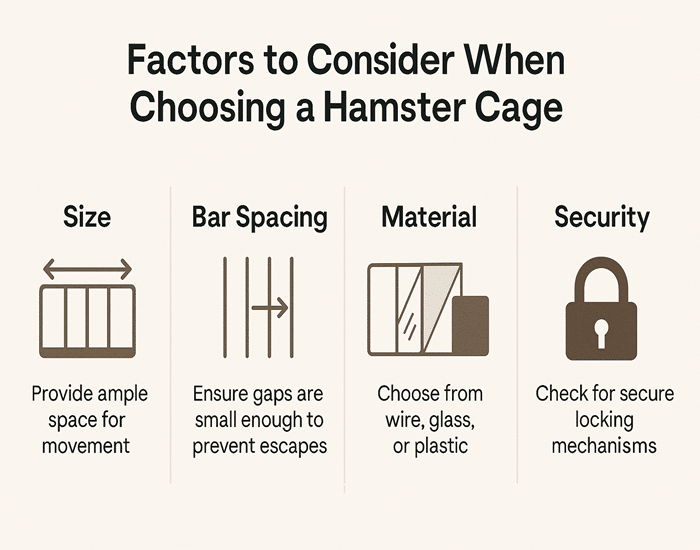
Trade-offs: shallow bases may limit bedding depth, and bar spacing must be appropriate for the hamster’s size.
Modified storage-bin enclosure
Advantages: can provide generous floor space at lower cost.
Trade-offs: safe modification requires a secure large ventilation panel and careful attention to chewable edges.
What every format needs
Blue Cross currently recommends housing around 100 cm × 50 cm floor space and 50 cm high as a baseline, with deep bedding, a suitable wheel, hides and enrichment.
Do not judge by levels alone
Vertical shelves do not replace continuous floor space for burrowing and exploring.
Security check
Test lids, bar spacing, clips, ventilation panels and cable openings before the hamster moves in.
For the full enclosure-selection framework, see our hamster enclosure guide. For what to put inside, use our hamster accessories guide.



0 comments