
Playtime for Senior Cats: Keep an Older Cat Moving Without Pushing Too Hard
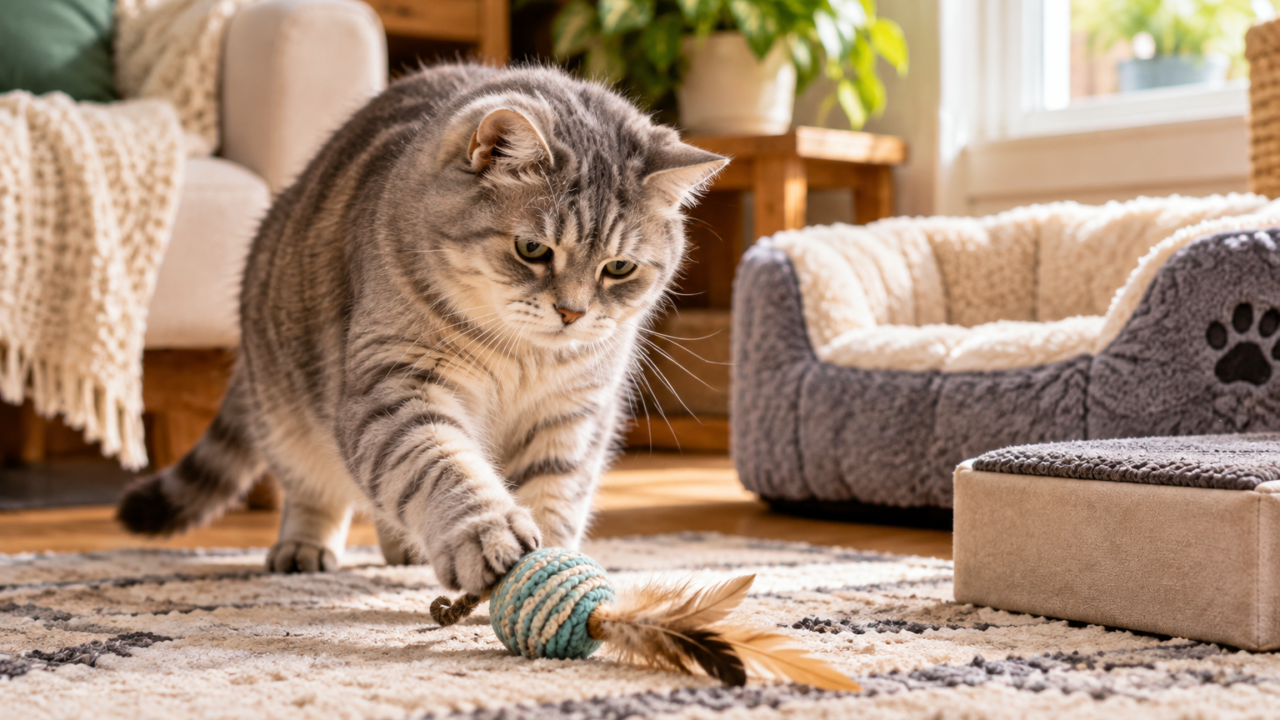
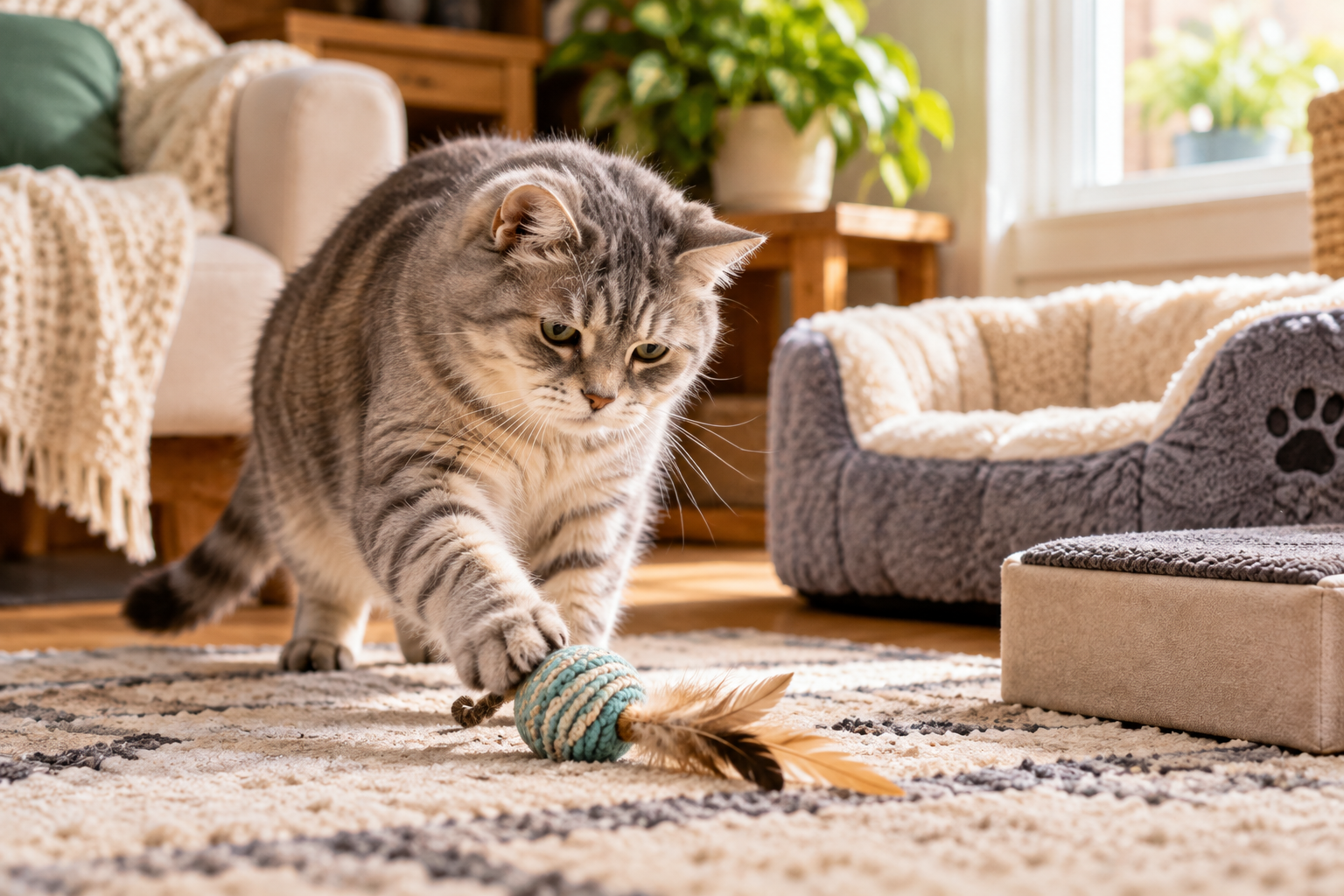
Older cats do not stop needing play when they stop launching themselves at the curtains. What changes is the way play should feel. A senior cat may prefer slower prey movement, shorter sessions, easier footing and toys that do not require repeated jumping.
AAHA recommends continuing mental and physical enrichment for older pets while tailoring activity to mobility and health. For cats, that often means keeping the hunting sequence but lowering the physical demand.
Start with what your cat still enjoys
If your cat still lights up when a feather wand appears, keep using it—but make the prey travel across the floor instead of flying over the sofa. If batting is easier than chasing, roll soft toys within reach. If vision has declined, use sound or scent to make the toy easier to track.
Short can be enough
A senior cat may prefer two or three minutes of focused play, then a break. That is not failure. The value comes from engagement and movement, not from matching a younger cat’s stamina.
Many older cats will return for another short session later in the day. Let them decide whether they want a second round.
Watch for the signs that play has become uncomfortable
Reduced jumping, hesitation on stairs, difficulty getting onto a favourite perch, stiffness after resting or abandoning a window seat can all be subtle mobility clues. AAHA/AAFP senior-cat guidance notes that degenerative joint disease is common and may first show up as changes in normal activity.
If those changes are new, treat them as health information rather than simply “slowing down.” Our cat arthritis guide covers signs that are easy to miss.
Use the floor more
A wand dragged around a box, behind a chair leg or beneath a paper bag can create a hunt without requiring high jumps. Keep footing stable with rugs or mats if hardwood or tile has become slippery.
Bring the game closer
Do not make an older cat cross the entire room every time. Start within easy reach, then add a little movement if the cat chooses to follow. A cat with arthritis may still enjoy the mental part of hunting even if the chase is small.
Build in successful catches
Older cats can become discouraged by games that are too fast. Slow the toy enough for a real stalk and pounce. Let the cat catch it, hold it and reset.
Puzzle feeding can count as activity too
AAHA recommends enrichment such as puzzles, toys and interactive play to support cognitive health in senior pets. Choose puzzles that are stable and easy to access rather than requiring hard pawing or repeated climbing.
Our food enrichment guide includes lower-effort options that can be adapted for older cats.
Keep favourite resources reachable
Play is easier when the rest of the home is comfortable. Add steps to a window perch, place beds in warm easy-to-reach locations and keep food, water and litter close to core resting areas when mobility declines.
For a broader home setup, see our senior cat care guide.
Do not use pain as a training problem
A cat who swats when picked up, refuses a toy that requires twisting or suddenly stops jumping may be protecting a painful body part. Pushing through that behaviour can make the cat more defensive.
What if your senior cat has stopped playing completely?
Some decline in intensity is normal with age, but a meaningful change deserves attention. Dental pain, arthritis, kidney disease, hyperthyroidism, vision changes and other conditions can alter activity. AAHA senior-care guidance specifically recommends watching for changes in usual habits, mobility and behaviour.
A senior-friendly play setup
Keep one soft wand toy, one easy batting toy and one simple food puzzle near the cat’s favourite room. Use non-slip flooring. Offer the game when the cat is already awake and alert. Stop before the cat looks tired.
Keep the invitation, lose the pressure
Senior play is less about exercise targets and more about preserving curiosity, movement and choice. A two-minute hunt that makes an older cat brighten, stalk and pounce is worthwhile. Let the cat set the pace and let veterinary care guide what their body can comfortably do.
Match the game to the cat’s current body
A senior cat that once leapt vertically after a toy may still enjoy the same hunt if the prey stays low. Keep the pattern familiar while changing the physical demand. Drag a wand around furniture legs, pause behind a box and let the cat stalk from a comfortable position.
Use traction to make play feel safer
Older cats may hesitate on laminate, tile or polished wood. Put a nonslip rug where play usually happens so the cat can push off and turn without sliding.
Warm up with easy movement
Start slowly rather than immediately asking for a chase. A few gentle reaches and short steps can help a stiff cat begin moving. If the cat loosens up and asks for more, increase activity gradually.
Do not make jumping the definition of successful play
A cat can stalk, bat, pounce from close range and solve a food puzzle without leaving the ground. Mental engagement counts even when athletic movement has changed.
Rotate between active and quiet enrichment
One day may suit a short wand session; another may suit scent exploration, a cardboard box, a simple puzzle feeder or watching birds from a secure window perch. Variety protects enrichment when mobility is inconsistent.
Use larger, slower toys when vision changes
A senior cat with reduced vision may track a larger toy more easily than a tiny fast object. Sound can help too, provided it does not startle the cat. Avoid laser-only play because there is nothing physical to catch at the end.
Hearing loss changes how you approach
If the cat no longer hears well, avoid suddenly touching from behind during play. Let the cat see you and the toy before starting so the session does not begin with a scare.
Cognitive changes can alter play routines
An older cat may become more confused at night, vocalise differently or seem less interested in familiar activities. Keep enrichment simple and predictable, and discuss significant behaviour changes with a veterinarian.
Pain medication can change what the cat is capable of
If a veterinarian is treating arthritis, note whether willingness to play improves. That information can help show whether pain control is making daily life easier. Do not alter medication based only on one energetic day.
Keep claws and paws comfortable
Overgrown claws or sore paws can make batting and running unpleasant. Check nails and footpads regularly, especially if scratching behaviour has decreased.
Feeders should not become strength tests
Puzzle feeders for senior cats should be stable and solvable. Avoid designs that require hard pawing, climbing or repeated bending if those movements are uncomfortable.
Let recovery time guide session length
If a cat seems stiff, tired or reluctant for hours after play, the session was probably too demanding. Shorten the next one and reduce jumping or twisting.
What if the cat still wants intense play?
Some healthy older cats remain highly active. Age alone does not require making every game slow. Let the individual cat’s health, body condition and veterinary advice determine what is appropriate.
Track change rather than chasing a daily target
You do not need a fixed number of minutes. Notice whether the cat still chooses to engage, whether movement remains comfortable and whether recovery is normal. A sudden drop in interest matters more than missing an arbitrary exercise quota.
A simple senior play rotation
- floor-level wand hunting;
- soft toy batting;
- easy food puzzle;
- cardboard-box exploration;
- short scent-search game;
- window watching from an accessible perch.
For older cats, play should protect curiosity and movement without turning enrichment into a physical test. The cat’s willingness, comfort and recovery tell you more than the clock.
0 comments