
Dog Keeps Chasing the New Cat: How to Stop Rehearsing the Chase and Reset the Introduction
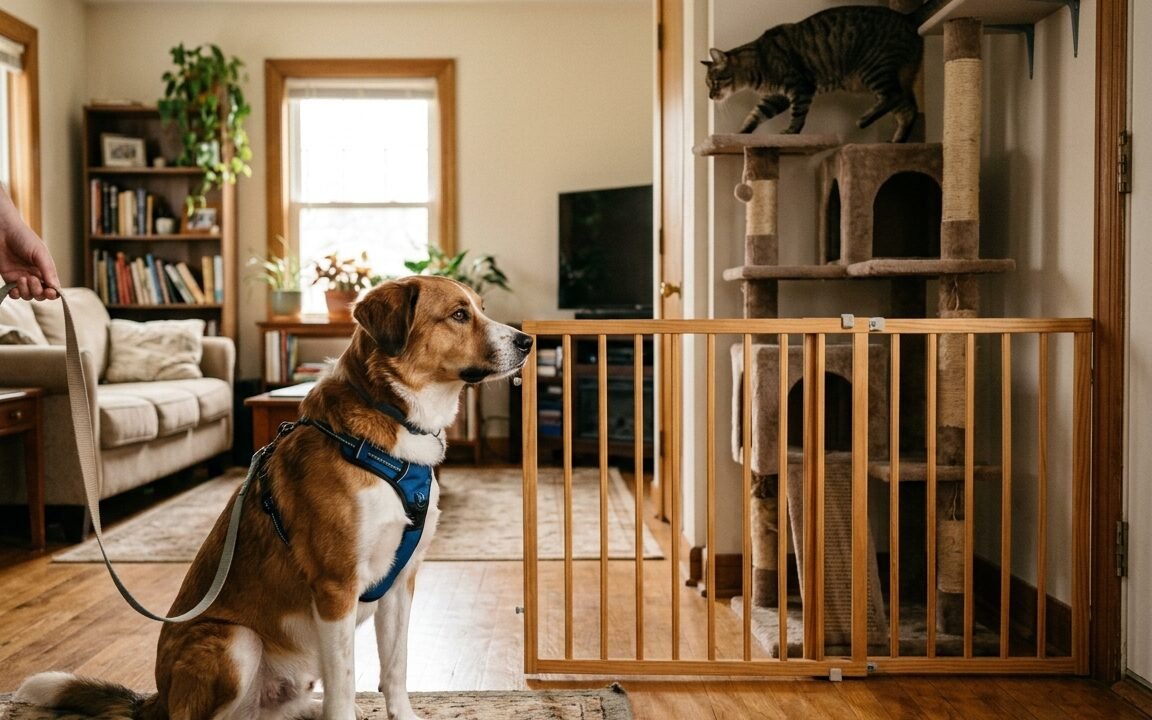
The most useful thing to know when a dog keeps chasing a new cat is this: do not keep giving them chances to “work it out.” Every successful chase can make the behaviour more exciting for the dog and more frightening for the cat. The fix starts with management, not a harder verbal correction.
If a chase has already happened, separate the animals and reset the introduction. A slower second attempt is usually safer than trying to recover while both pets are still aroused.
First, stop access to unsupervised chasing
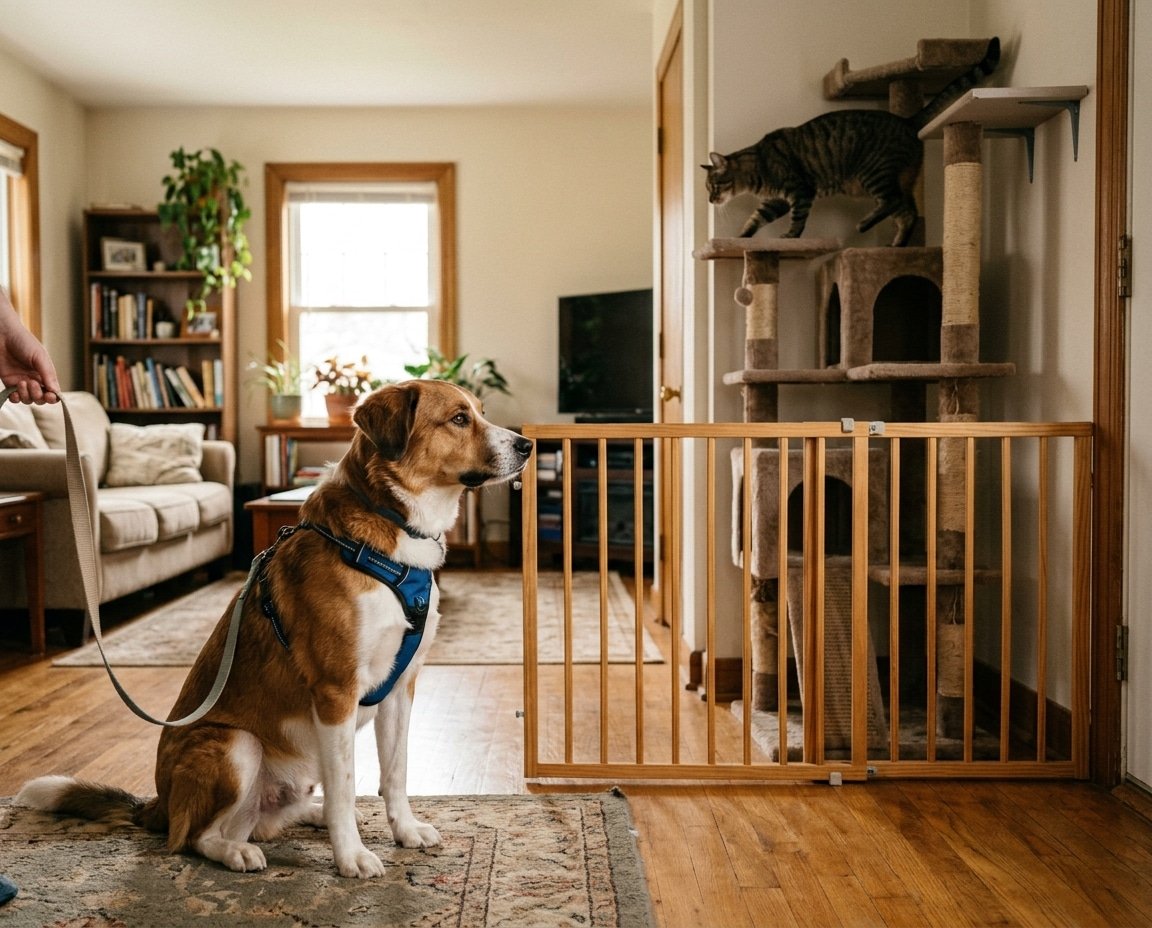
Use doors, sturdy gates, a leash or a carefully arranged room so the dog cannot launch into another chase. The cat needs a dog-free area with litter, food, water, resting places and hiding options. That space should remain available even after introductions improve.
The RSPCA dog-and-cat introduction guidance recommends protected, controlled contact rather than allowing direct access too early.
Ask why the dog is chasing
Not every chase has the same motivation. A young dog may be overexcited. A herding breed may react strongly to movement. Another dog may show predatory behaviour that is far more serious. Look at the whole sequence: does the dog bounce and disengage easily, or become silent, stiff and intensely focused?
Hard staring, freezing, stalking and an inability to respond to familiar cues deserve more caution than loose-bodied curiosity.
Distance is your first training tool
Bring the dog to a distance where the cat can be seen but the dog can still eat, respond to a known cue and look back at you. If the dog cannot disengage, you are too close.
Reward the moment the dog notices the cat and then turns away. You are building a new pattern: cat appears → dog stays grounded → dog gets reinforced for calm choices.
Do not wait for the lunge
Owners often try to intervene only after the dog explodes forward. The more useful moment is several seconds earlier: eyes lock, mouth closes, body leans forward, movement slows. Increase distance then.
Give the cat routes the dog cannot control
Vertical territory matters. Cat trees, shelves and furniture routes can let the cat cross a room without running past the dog. Avoid layouts where the cat must squeeze through a doorway beside the dog to reach litter or food.
Keep the leash loose enough to observe the dog
A tight leash can add frustration and hide whether the dog can regulate itself. The leash is a safety line, not a tool for dragging the dog closer or holding the dog inches from the cat.
Do not use the cat as a training prop
The cat should not be held, carried toward the dog or confined in a way that prevents retreat merely so the dog can practise. The cat’s ability to create distance is part of the safety plan.
If the cat runs, expect the difficulty to increase
Movement can trigger chasing even in a dog that looked calm beside a stationary cat. That is why early sessions should happen with enough physical control that one sudden sprint cannot turn into a rehearsal.
Practise calm behaviour before the cat enters
Useful foundation skills include responding to a name, settling on a mat, turning away from a distraction and following a handler calmly. Train those separately so you are not teaching them for the first time beside the cat.
Food and toys can raise the stakes
Remove high-value chews and feed pets separately during early introductions. You do not want the dog-cat relationship tangled with guarding or competition.
What if the dog chased only once?
Treat it as useful information. Do not panic, but do not dismiss it because no injury occurred. Go back to barriers and distance, then progress more slowly.
What if the dog keeps trying to chase despite training?
If the dog remains intensely fixated, has injured small animals before, cannot disengage around the cat or repeatedly breaks through management, involve a qualified behaviour professional. Some dog-cat combinations require permanent separation rather than a training experiment.
Know when the cat is not coping
A cat that stops eating, avoids the litter box, stays hidden, overgrooms or no longer moves through the home normally is not simply “being dramatic.” Reduce exposure and protect the cat’s core resources.
If fear is the main issue, our guide on a new cat scared of the resident dog focuses on rebuilding feline confidence.
Return to the full introduction plan
For the complete scent → barrier → distance → supervised-access sequence, use our dog and cat introduction guide. A chase is a reason to move backward in that sequence, not a reason to skip forward.
A successful outcome is not a photo of the animals touching noses. It is a home in which the dog can notice the cat without launching after it and the cat can move, eat, sleep and use the litter box without planning an escape route.
Separate excitement from predatory concern
A bouncy dog that can turn away, take food and respond to cues is different from a dog that becomes silent, stiff and intensely focused on the cat. Both need management, but hard staring, stalking and inability to disengage justify a more cautious plan.
Use barriers before relying on obedience
A strong “leave it” is helpful, but it should not be the only thing preventing a chase. Doors, gates and leash control provide physical safety while training catches up.
Practise disengagement away from the cat first
Teach the dog to look at a mild distraction and then return attention to you. Practise settling on a mat and turning away from moving objects in easy contexts. Those skills are more reliable around the cat when they are already familiar.
Movement is the hardest stage
A dog may stay calm while the cat sits still but become aroused when the cat walks or runs. Progress only when the dog can handle increasing amounts of normal cat movement without lunging or locking on.
Do not make the cat “prove” the dog is safe
Letting the cat loose to see what happens is not a test. It places the risk on the cat. Use controlled setups where a sudden movement cannot become a full chase.
Keep the dog’s daily needs met
A dog with no exercise, sniffing or training outlets may arrive at cat sessions over-aroused. Meet normal physical and mental needs separately so the cat is not the most exciting event of the day.
Use calm enrichment after sessions
A chew, food puzzle or settle period can help the dog decompress after a short introduction session. Keep high-value resources away from the cat to avoid adding guarding concerns.
Protect the cat’s routines
The cat should continue eating, sleeping, grooming and using the litter box normally. If those routines deteriorate, reduce exposure and restore more separation even if the dog seems to be improving.
Do not rush unsupervised access
Several successful sessions do not guarantee safety when nobody is present. Continue separation until the pattern has been stable over time and a qualified professional has advised otherwise when risk is high.
Record what triggers the chase
Note whether chasing starts when the cat runs, jumps down, approaches food or appears suddenly. That information helps you design safer training setups and gives a behaviour professional useful context.
When permanent management may be kinder
Some dog-cat combinations never become safe for unrestricted contact. Separate zones, gates and scheduled access can still create a workable household. Success does not require forcing the animals to share every room.


0 comments