
The Osprey in Shakespeare’s Coriolanus: What the Image Means
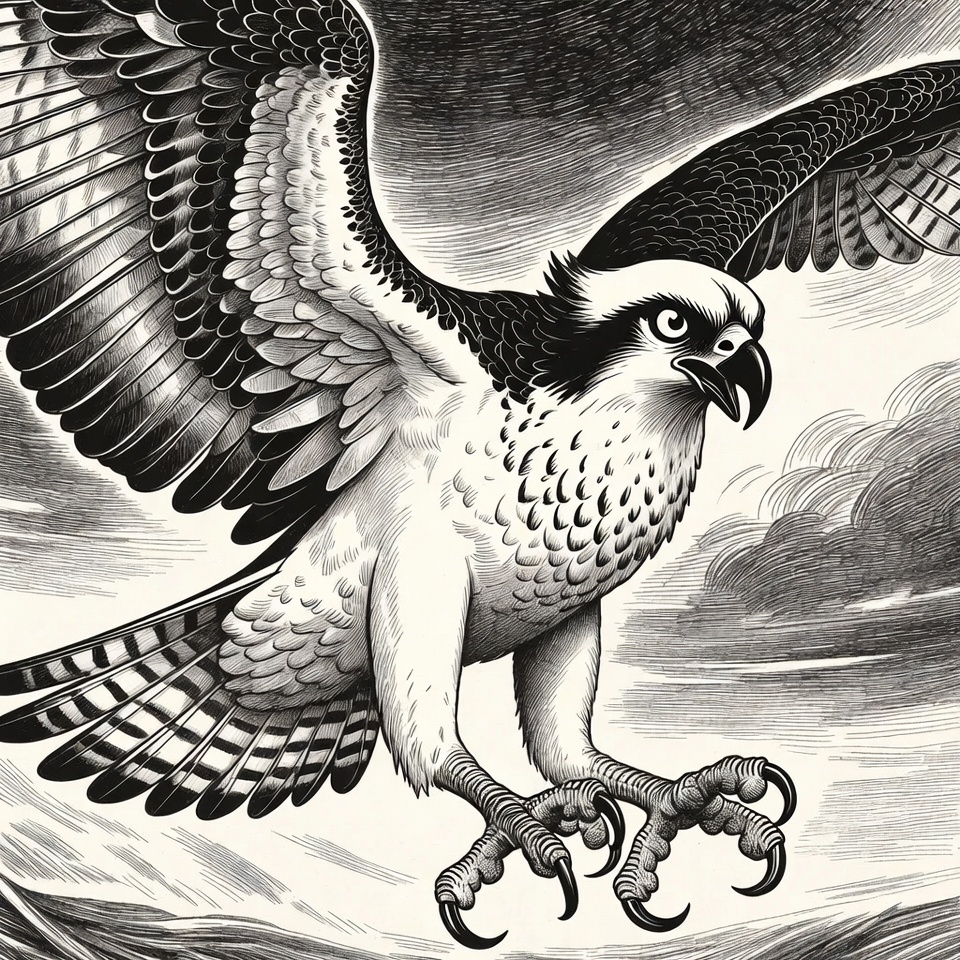
Shakespeare’s osprey appears in Coriolanus, Act 4, Scene 7, when Aufidius considers how dangerous Coriolanus has become to Rome. The comparison is brief but precise: Coriolanus is imagined as holding the same natural advantage over Rome that an osprey has over fish.
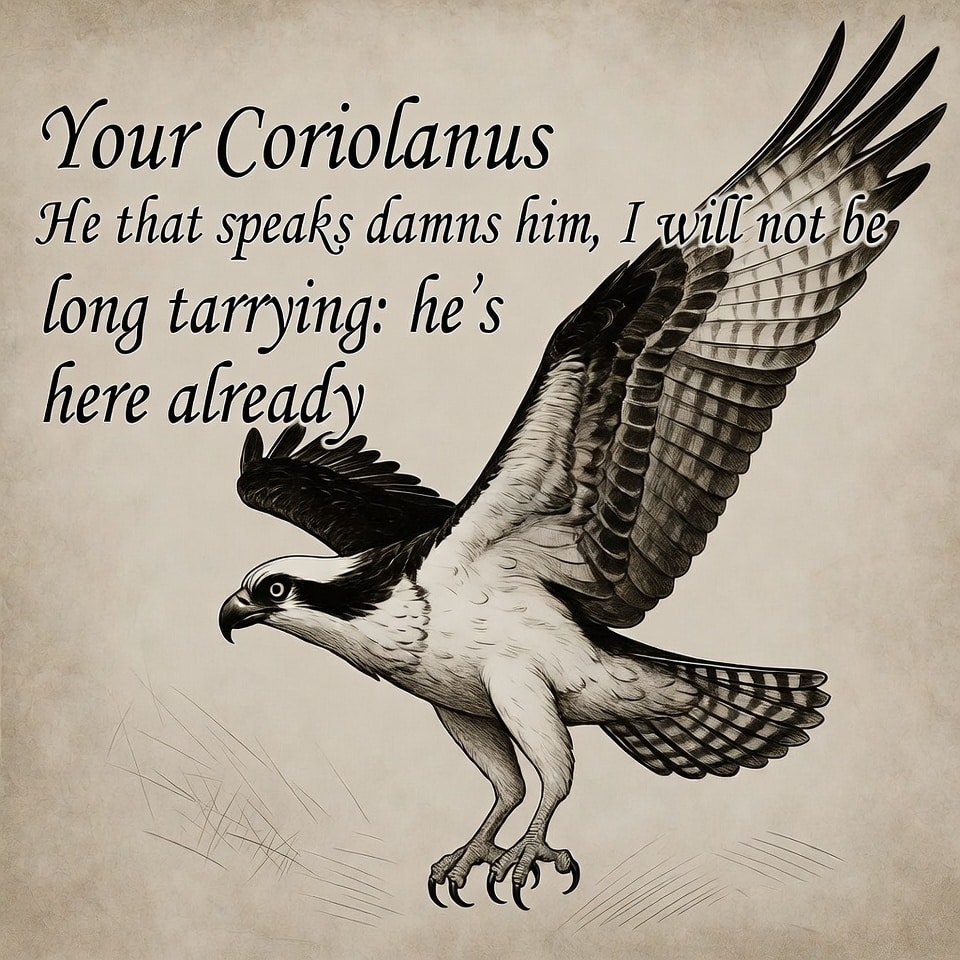
The Folger Shakespeare Library text of Act 4, Scene 7 places the image inside Aufidius’s assessment of Coriolanus’s military strength and Rome’s weakness. That context matters more than treating the bird as a free-floating symbol.
What happens before the osprey image?
By this point, Coriolanus has been banished from Rome and joined forces with his former enemy Aufidius and the Volscians. He is now marching against his own city.
Aufidius and a lieutenant discuss how quickly places are yielding to Coriolanus and how vulnerable Rome appears.
The key comparison
Aufidius says that Coriolanus will be to Rome as the osprey is to fish, taking its prey “by sovereignty of nature.”
The important idea is not merely that an osprey is impressive. It is that the predator seems to possess a natural, overwhelming advantage.
Why an osprey works as the image
Ospreys are specialized fish hunters. They search over water, dive feet-first and seize fish with powerful talons.
That natural behavior makes the political metaphor legible: Rome is imagined as exposed prey, while Coriolanus is the predator equipped for exactly this kind of conquest.
“Sovereignty of nature”
The phrase strengthens the comparison. Aufidius is not describing a lucky victory. He imagines an advantage built into the natural order.
For a few lines, Coriolanus appears almost inevitable.
The irony: Aufidius is not simply praising him
Aufidius admires Coriolanus’s power, but he is also his rival. The speech continues into a discussion of the flaws that brought Coriolanus to this point.
That makes the osprey image more complicated than a straightforward compliment.
Power and self-destruction
Coriolanus repeatedly asks whether military greatness can function inside civic life. Coriolanus’s strengths as a warrior do not translate easily into political compromise.
The osprey comparison captures the height of his military advantage just before the play continues exploring the weaknesses that accompany that power.
Predator and prey imagery
Shakespeare often uses animals to sharpen human power relationships. Here, the osprey-fish relationship creates an asymmetry: the fish does not compete with the osprey on equal terms.
That is exactly how Aufidius imagines Rome’s position.
Why not an eagle?
An eagle might suggest majesty, empire or generalized power. The osprey is more specific because its relationship with fish is the point.
The metaphor depends on ecological specialization rather than royal symbolism.
Natural history and literary meaning
It is useful to know that ospreys catch fish, but literary analysis should stop short of pretending Shakespeare is writing modern ornithology.
The bird’s hunting behavior supports the metaphor; the surrounding speech determines what that metaphor means in the play.
Do not overstate a Shakespeare-wide osprey symbolism
This is not a recurring emblem developed across multiple plays. The strength lies in one concentrated comparison.
Claims that “the osprey always symbolizes sovereignty in Shakespeare” would go beyond the evidence.
Aufidius as the speaker matters
The comparison comes from Coriolanus’s enemy and temporary ally, not from an objective narrator.
Aufidius has his own motives. He recognizes Coriolanus’s ability and also watches for the moment when that ability can be turned against him.
Rome as vulnerable prey
The image also says something about Rome. The city that expelled Coriolanus now faces the possibility that its former defender has become its greatest military threat.
The predator-prey comparison dramatizes the reversal.
Coriolanus and “nature”
The play repeatedly examines whether Coriolanus can be anything other than what his temperament and upbringing have made him.
Aufidius’s language about “nature” fits that broader concern: strength can look innate, but inflexibility can also become a trap.
How to use the passage in an essay
A strong paragraph can make three moves:
- Place the image in Act 4, Scene 7 after Coriolanus has joined the Volscians.
- Explain the real predator-prey relationship between osprey and fish.
- Connect “sovereignty of nature” to the temporary imbalance of power between Coriolanus and Rome.
Then add the irony that this apparent natural supremacy does not secure Coriolanus’s final survival.
What not to write
Avoid saying the osprey is a general Shakespearean symbol of freedom, spiritual awakening or kingship unless you have textual evidence for that claim.
Stay close to Aufidius’s speech.
The bird itself
For readers interested in the animal rather than only the metaphor, our osprey natural-history guide covers hunting, habitat and ecology.
Why this tiny reference is memorable
The image compresses a large political argument into one visual scene: a specialized predator descending on prey that seems unable to resist.
That economy is why the passage is worth studying even though the osprey appears only briefly.
How the image fits the play’s larger political structure
Coriolanus repeatedly contrasts military competence with political adaptability. The hero succeeds where command, courage and force are rewarded, but struggles in settings that require persuasion, negotiation and compromise.
The osprey image belongs to the moment when his military identity looks most powerful. It therefore sharpens the later tragedy: superiority in one arena does not guarantee survival in another.
Aufidius and competitive admiration
Aufidius’s language combines admiration with rivalry. He knows Coriolanus is extraordinarily effective, but he also understands that power changes relationships inside the Volscian camp.
Reading the metaphor through Aufidius helps prevent a simplistic interpretation in which Shakespeare himself is merely celebrating Coriolanus as a noble bird of prey.
Compare Shakespeare’s other bird images carefully
Shakespeare uses different birds for very different rhetorical jobs. The starling in our Henry IV starling guide, for example, works through mimicry and repetition rather than predation.
That contrast is a useful reminder that bird imagery should be interpreted locally, from the action and language of each passage.
The metaphor is effective because it is economical
Shakespeare does not pause to explain the bird. A single ecological relationship—osprey over fish—lets Aufidius summarize military imbalance immediately. That economy is one reason animal imagery works so well in the play: it can make hierarchy visible without a long political explanation.
For close reading, this is stronger than assigning dozens of abstract meanings to the bird. The image already does enough when read carefully in context.
Reading the image aloud
The metaphor also works aurally because it arrives inside a rapid political assessment rather than as a decorative pause. Its force comes from clarity: predator, prey, advantage. That sharpness matches Aufidius’s compressed judgment of the military situation.
For students, the strongest evidence is the wording around the image itself: Aufidius is judging military probability, not writing a catalogue of bird symbolism.
Its precision is the point: one bird, one prey relationship, one sudden picture of political dominance.
Why the image helps readers understand Aufidius
Aufidius is both impressed and threatened by Coriolanus. His choice of such an efficient predator acknowledges the Roman’s strength while also revealing how closely he is watching that strength. The metaphor therefore contributes to the rivalry as well as the military assessment.
Bottom line
In Coriolanus, the osprey is not decorative bird imagery. Aufidius uses it to describe Coriolanus’s apparent natural dominance over a vulnerable Rome. The image works because an osprey is a specialist fish predator, while the surrounding speech adds irony: the same Coriolanus who seems unbeatable militarily remains vulnerable to pride, politics and rivalry.


0 comments