
Affordable Dog Food: How to Compare Quality on a Budget

An affordable dog food should not be judged by price alone, and an expensive bag is not automatically a better choice. The useful comparison is whether the food is nutritionally appropriate for your dog, whether the manufacturer provides meaningful information about the product and whether the real cost per day fits your household.
Compare nutritional quality while staying within your dog-food budget. If your main goal is to calculate package value, calorie density and food waste, use our budget dog food cost-per-day guide. Here, the focus is how to avoid false economies while still controlling spending.
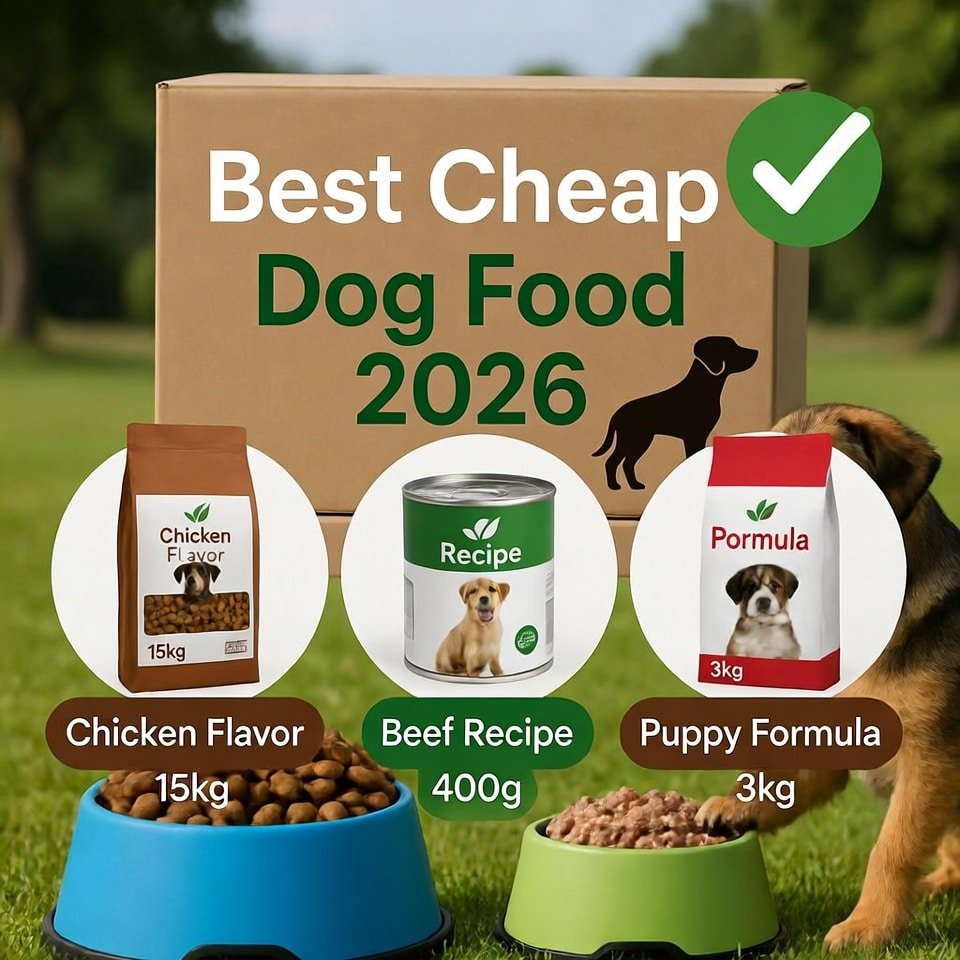
Start with nutritional adequacy, not the front of the bag
One of the most important parts of a dog-food label is the nutritional adequacy statement. It tells you whether the food is intended to be complete and balanced and for which life stage.
The Association of American Feed Control Officials explains how to use pet-food labels when selecting a product. In practical terms, an adult maintenance food is not automatically appropriate for a growing puppy, and a food for growth may need to meet specific requirements for puppies expected to become large adults.
Before comparing price, make sure you are comparing foods designed for the same purpose.
“Premium” does not tell you whether a food is suitable
Marketing words can make a budget food look inferior even when the label provides the nutritional information your dog needs. Terms such as “premium,” “holistic” and “natural” do not by themselves tell you about formulation expertise, quality control or whether the diet suits a particular medical condition.
A practical buyer asks better questions: Is it complete and balanced for the correct life stage? How many calories does it provide? Can the manufacturer answer detailed questions? Does the dog maintain a healthy body condition and normal stool on it?
Compare cost per day, not only bag price
A cheaper bag can cost more to feed if the dog needs a larger amount each day. A larger bag may have a higher checkout price but lower daily cost. Calorie density matters because two foods can have very different calories per cup or per gram.
To estimate daily cost:
- Find the calories per cup, can or kilogram on the label.
- Use the feeding guide only as a starting estimate.
- Work out approximately how much your dog will eat each day.
- Estimate how many days the package should last.
- Divide the purchase price by the number of feeding days.
Then adjust based on the dog’s actual body condition. Feeding guides cannot account perfectly for every dog’s metabolism and activity.
Use body condition, not the empty bowl, as feedback
Many dogs will happily eat more food than they need. The fact that a dog finishes the bowl does not prove the portion is correct.
Learn to assess body condition with your veterinary team. You should be able to monitor waist shape, abdominal tuck and how easily the ribs can be felt. Weight trends over time are also more informative than appetite alone.
Ask what the manufacturer can tell you
The World Small Animal Veterinary Association’s nutrition resources encourage pet owners to look beyond ingredient-list marketing and ask about formulation, nutrition expertise, quality control and the ability to provide detailed nutrient information.
A useful question is not “Is this brand on a good list?” but “Can the company explain how the food is formulated and controlled?” Transparency is relevant at every price point.
Ingredient lists have limits
Ingredient lists are required, but they are easy to overinterpret. Ingredients are listed by weight before processing, which means moisture can influence position. The list also does not tell you the quality of every ingredient or the nutrient balance of the finished diet.
Do not automatically reject a food because a familiar ingredient appears lower on the list, and do not assume a food is superior because the first ingredients sound appealing to humans.
Do not pay extra for claims your dog does not need
Some foods charge more for novel proteins, grain-free formulations, exotic ingredients or lifestyle branding. Those features may be useful in specific circumstances, but they are not automatically better for a healthy dog.
If your veterinarian has not identified a medical reason for a specialized formulation, compare whether the extra cost is actually buying something relevant to your dog.
Puppies require the right growth diet
Saving money by feeding a puppy adult maintenance food can be a false economy. Growing dogs have different nutritional requirements. Large-breed puppies also need appropriate control of energy and minerals during growth.
Our puppy food selection guide explains how to identify a growth-appropriate diet without turning the process into a brand popularity contest.
Medical conditions can change what “affordable” means
A bargain is not a bargain if the diet is inappropriate for the dog. Dogs with kidney disease, pancreatitis, gastrointestinal disease, food-responsive illness or other medical problems may need a more specific feeding plan.
Therapeutic veterinary diets can be expensive because they are designed for particular clinical purposes. Do not replace one with a cheaper over-the-counter food without discussing the consequences with the veterinarian managing the condition.
Be cautious with homemade substitutions
Cooking at home can sound cheaper and more wholesome, but creating a complete and balanced long-term diet is not simply a matter of combining meat, rice and vegetables. Nutrient deficiencies and excesses can develop when recipes are improvised.
If a home-prepared diet is medically or personally important, work with a veterinary nutrition professional rather than relying on social-media recipes.
Budget for treats, toppers and chews
Treats can become a hidden food bill. Cheese, deli meat, dental chews, training treats and toppers may add substantial calories and cost even when the main food is reasonably priced.
Use part of the dog’s regular ration for training when possible. The AAHA nutrition guidance recommends keeping extras limited so complete and balanced food remains the nutritional base.
Supplements are not automatically money well spent
A complete and balanced diet is formulated to provide required nutrients. Adding a multivitamin or mineral supplement without a reason can be unnecessary and, in some cases, can upset nutrient balance.
Ask what problem a supplement is supposed to solve, whether there is evidence for it and whether the dose is appropriate before adding another recurring expense.
Buy the right bag size for your household
A huge bag may have the lowest price per pound, but that only saves money if the food is stored properly and used while it remains fresh. Small households with tiny dogs may waste food from oversized packages.
Store dry food in a cool, dry place and keep the original packaging information available so lot numbers and expiration details are easy to find if a recall occurs.
Watch current recall and safety information
No brand has a permanent “safe” or “unsafe” status. Manufacturing, formulas and recalls can change. For current U.S. information, check the FDA’s animal-food outbreaks and advisories rather than relying on a static internet blacklist.
Our dog food safety evaluation guide explains why permanent “worst brand” lists can mislead when they are detached from current evidence.
Switch foods gradually when possible
A sudden change can cause digestive upset in some dogs. When there is no urgent medical reason to switch immediately, transition gradually over several days according to your veterinarian’s advice and the dog’s tolerance.
If vomiting, persistent diarrhea, itching or other concerning signs appear, do not keep switching repeatedly without investigating the cause.
Generic and store brands: what to check
A store brand should be evaluated using the same criteria as any other food. Read the adequacy statement, identify the manufacturer or responsible company, check calorie information and contact the company if you have formulation or quality-control questions.
Price is a legitimate consideration, but “cheap” is not a nutritional category.
A practical affordable-food checklist
- Complete and balanced for the correct life stage.
- Appropriate for the dog’s medical needs.
- Calorie information is available.
- Daily feeding cost fits the household budget.
- The company provides meaningful product information.
- The dog maintains healthy body condition and normal stool.
- Treats and toppers do not overwhelm the calorie budget.
- Food is stored and used in a way that minimizes waste.
- Current safety notices are checked when concerns arise.
When a higher-priced food may actually save money
A more expensive product can still be better value if the dog needs less of it per day, tolerates it well and wastes less. Conversely, an expensive food that requires unnecessary supplements or does not suit the dog can be poor value.
This is why cost per day and suitability matter more than price per bag.
Bottom line
Affordable dog food is a decision process, not a brand list. Start with nutritional adequacy and life-stage fit, compare the real daily feeding cost, evaluate manufacturer transparency and watch the individual dog’s body condition and health. Spend where it protects nutrition and medical needs, and cut costs where marketing extras do not add meaningful value.



0 comments