
Does an Octopus Have a Skeleton? How Its Body Is Supported
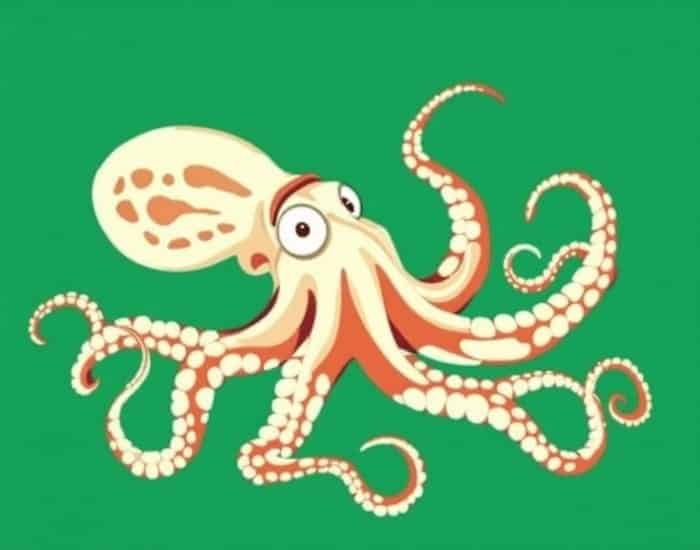
An octopus does not have a bony internal skeleton. It also lacks the external shell seen in many other mollusks. This soft-bodied anatomy is one reason octopuses can bend, stretch and pass through openings only slightly larger than their hard beak.

How can an animal move without bones?
Octopus arms are built from densely arranged muscle rather than bones and joints. This muscular-hydrostat system allows an arm to bend, shorten, lengthen and twist in many directions while maintaining control.
What hard parts does an octopus have?
The most important hard structure is the beak, located where the arms meet. The beak is used to bite and process prey. Because it is rigid, it can limit the smallest opening an octopus can pass through.
What happened to the mollusk shell?
Octopuses are cephalopod mollusks, relatives of squid, cuttlefish and nautiluses. Their evolutionary lineage reduced the shell dramatically, leaving modern octopuses with a highly flexible body.
Does flexibility make them fragile?
Soft tissue can still generate powerful movement. Octopuses use coordinated muscles, suckers and jet propulsion for locomotion and handling prey. Their lack of bones is an adaptation, not a sign of a structurally unsupported body.
What about the beak?
Our octopus beak guide explains how this hard feeding structure fits into an otherwise soft body.
Muscular hydrostats are the key
Octopus arms work without bones because muscle fibers are arranged in several directions. Contracting one set while another resists allows the arm to bend, elongate, shorten and stiffen with remarkable control.
Water and tissue create support
Soft-bodied animals can maintain shape through pressure and muscular tension rather than rigid skeletons. The body is flexible, but it is not structurally random or unsupported.
Each arm can act semi-independently
Large portions of the octopus nervous system are distributed through the arms. That allows local sensory processing and movement while the central brain coordinates broader goals.
Suckers add both grip and sensation
Suckers are not just suction cups. They can grasp surfaces, manipulate objects and provide chemical and tactile information about the environment.
The mantle is a muscular body wall
The mantle surrounds major internal organs and can contract to move water through the siphon. Those contractions are central to respiration and jet propulsion.
Jet propulsion does not require bones
By forcing water through the siphon, an octopus can move rapidly. Direction is controlled by changing the orientation of the siphon and body.
Crawling is often more efficient than jetting
Many octopuses move slowly across the seafloor using coordinated arm movements because continuous jet propulsion is energetically expensive.
The beak is one of the main hard limits
The beak is rigid and cannot compress like surrounding tissue. A healthy octopus can often pass through a gap large enough for the beak even when the rest of the body looks much wider.
The eyes and internal organs also need protection
Flexibility does not mean the animal can be squeezed without harm. Internal organs, eyes and nerves can still be injured by pressure or rough handling.
Octopuses do not “pour” through holes like liquid
The body remains under muscular control as the animal explores an opening. Arms probe first, and the animal actively reshapes itself rather than passively flowing.
Why shells were reduced in octopus evolution
Losing a large external shell increased flexibility and may have opened new hiding and hunting opportunities, but it also removed a major physical defense.
Behavior replaces some structural protection
Camouflage, hiding, ink release, rapid movement and narrow-den use can compensate for the lack of a protective shell.
Cephalopod relatives use different structural solutions
Nautiluses retain an external shell, cuttlefish have a cuttlebone and squid have a flexible internal pen. Octopuses represent one extreme of shell reduction.
Bone-free does not mean simple anatomy
The combination of muscle, connective tissue, pressure, sensory control and distributed neural processing makes octopus movement one of the most sophisticated examples of soft-body locomotion.
Why this matters for aquarium design
Captive octopuses can exploit tiny gaps because rigid skeletal width does not limit them the way it limits vertebrates. Enclosures therefore require exceptionally secure lids and openings.
Connective tissue helps transmit force
Muscle does not work in isolation. Connective tissues help organize and transfer force through the arms, giving soft structures enough stiffness for controlled pushing, pulling and grasping.
Arm stiffness can change moment to moment
An arm can be flexible while exploring, then become much more rigid while pushing against the substrate or restraining prey. This variable stiffness is one reason soft-body movement is so versatile.
Soft-body control is computationally demanding
A rigid skeleton limits possible joint angles; an octopus arm has far more possible shapes. The nervous system therefore manages a movement problem very different from that of a vertebrate limb.
Hydrodynamics influence movement
Water supports body mass and changes how forces act on soft tissue. An octopus out of water does not move the same way it does in its natural aquatic environment.
Why soft robotics studies octopus movement
Engineers study octopus arms because they solve movement without rigid joints. Flexible robots inspired by muscular hydrostats may be useful where conventional jointed machines are too stiff or fragile.
Arm coordination is both local and central
Local arm circuits can handle some movement details, while the central nervous system sets larger goals. That division helps explain how eight highly flexible arms can work without constant conscious control of every segment.
Body shape changes with task
An octopus can flatten, elongate or compact the body depending on whether it is hiding, squeezing, swimming or confronting prey. Shape is therefore dynamic rather than fixed.
Skin itself contributes to function
Color and texture change through specialized skin structures, adding camouflage and communication to the same body that must also bend and squeeze mechanically.
Soft anatomy enables unusual escape behavior
An octopus can investigate narrow gaps with one arm, test the opening and then reshape the mantle and remaining arms to follow. This is why aquarium keepers must treat lids, plumbing and cable openings as potential escape routes.
There is still a physical limit
The beak, eyes and internal organs cannot compress infinitely. Flexibility should not be exaggerated into the claim that an octopus can fit through any tiny hole.
Muscle arrangement creates controllable stiffness
By contracting different muscle groups together, an arm can become firm enough to push against rock or support the body, then soften again for exploration.
Soft-bodied design supports camouflage too
Because the skin and body surface can deform, texture changes can work alongside color changes, helping the animal blend into complex reef or seafloor backgrounds.
Movement is coordinated with sensation
Suckers continuously gather tactile and chemical information while the arms move. The body is therefore sensing and acting at the same time rather than moving blindly.
The absence of bones is therefore not a lack of support. Octopus movement depends on coordinated muscle, connective tissue, fluid pressure and neural control working together continuously.
Octopus support comes from muscle, pressure, connective tissue and neural control working together rather than from bones.
Soft support is still support: muscles, connective tissue, fluid pressure and neural control give the octopus both strength and flexibility.
Flexibility and support work together throughout the body.
Soft-body support remains highly controlled.


0 comments